
Join Our JEE Preparation Group
Prep with like-minded aspirants; Get access to free daily tests and study material.
Sign in
Please select an account to continue using cracku.in
↓ →
Join Our JEE Preparation Group
Prep with like-minded aspirants; Get access to free daily tests and study material.
A convex lens of focal length $$20 \text{ cm}$$ is placed in front of convex mirror with principal axis coinciding each other. The distance between the lens and mirror is $$10 \text{ cm}$$. A point object is placed on principal axis at a distance of $$60 \text{ cm}$$ from the convex lens. The image formed by combination coincides the object itself. The focal length of the convex mirror is ______ cm.
Correct Answer: 10
We need to determine the focal length of the convex mirror when it is placed in combination with a convex lens such that the final image coincides with the point object itself.
Using the lens formula, we find where the convex lens forms the first image:
$$\frac{1}{v} - \frac{1}{u} = \frac{1}{f_{\text{lens}}}$$
From the problem
Substitute these values to solve for the image distance ($$v$$):
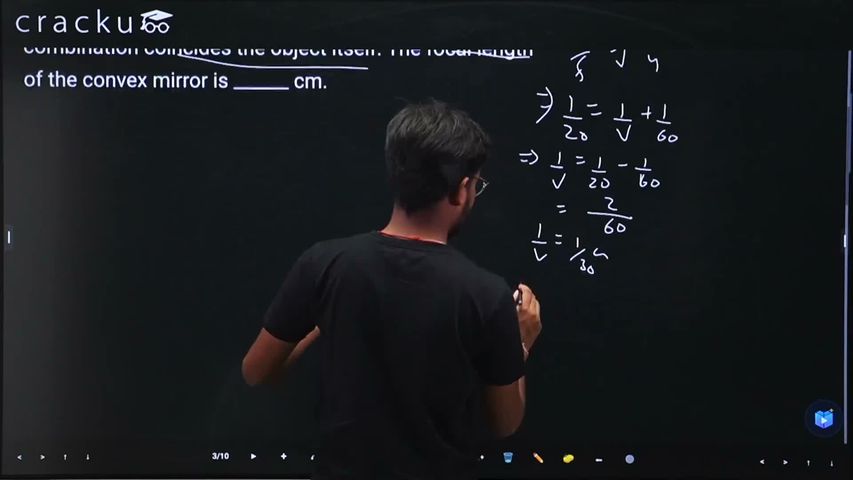
$$\frac{1}{v} - \frac{1}{-60} = \frac{1}{20}$$
$$\frac{1}{v} + \frac{1}{60} = \frac{1}{20}$$
$$\frac{1}{v} = \frac{1}{20} - \frac{1}{60} = \frac{3 - 1}{60} = \frac{2}{60} = \frac{1}{30}$$
$$v = 30\text{ cm}$$
This means the lens forms a real image $$30\text{ cm}$$ behind it.
The problem states that the final image retraces its path and coincides with the object itself. For a light ray to retrace its path after hitting a spherical mirror, it must strike the mirror surface normally (perpendicularly).
This happens only if the rays heading from the lens are directed straight toward the center of curvature ($$C$$) of the convex mirror.
Therefore, the distance from the mirror to its center of curvature ($$R$$) is:
$$R = 30\text{ cm} - 10\text{ cm} = 20\text{ cm}$$
The relationship between the focal length and the radius of curvature for a spherical mirror is:
$$f_{\text{mirror}} = \frac{R}{2}$$
$$f_{\text{mirror}} = \frac{20}{2} = 10\text{ cm}$$
The focal length of the convex mirror is 10 cm.
Was this solution helpful?
Click on the Email ☝️ to Watch the Video Solution
Create a FREE account and get:
_1.webp)

Educational materials for JEE preparation

Ask our AI anything

AI can make mistakes. Please verify important information.
AI can make mistakes. Please verify important information.
