
Join Our JEE Preparation Group
Prep with like-minded aspirants; Get access to free daily tests and study material.
Sign in
Please select an account to continue using cracku.in
↓ →
Join Our JEE Preparation Group
Prep with like-minded aspirants; Get access to free daily tests and study material.
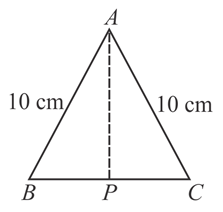
Cross-section view of a prism is the equilateral triangle $$ABC$$ shown in the figure. The minimum deviation is observed using this prism when the angle of incidence is equal to the prism angle. The time taken by light to travel from P (midpoint of BC) to A is _________ $$\times 10^{-10}$$ s. (Given, speed of light in vacuum = $$3 \times 10^8$$ m s$$^{-1}$$ and $$\cos 30° = \frac{\sqrt{3}}{2}$$)
Correct Answer: 5
We need to calculate the time taken by light to travel along the altitude $$PA$$ inside an equilateral triangular prism under the given minimum deviation conditions
For an equilateral triangle prism, the prism angle is:
$$A = 60^\circ$$
We are given that at minimum deviation, the angle of incidence ($$i$$) is equal to the prism angle ($$A$$):
$$i = A = 60^\circ$$
In the condition of minimum deviation, the angle of refraction ($$r$$) inside the prism relates to the prism angle by:
$$r = \frac{A}{2} = \frac{60^\circ}{2} = 30^\circ$$
Applying Snell's Law at the first refracting surface:
$$\mu = \frac{\sin(i)}{\sin(r)} = \frac{\sin(60^\circ)}{\sin(30^\circ)} = \frac{\left(\frac{\sqrt{3}}{2}\right)}{\left(\frac{1}{2}\right)} = \sqrt{3}$$
The speed of light inside a medium depends on its refractive index:
$$v = \frac{c}{\mu} = \frac{3 \times 10^8}{\sqrt{3}} = \sqrt{3} \times 10^8\text{ m/s}$$
From the given image layout, the side length of the equilateral triangle cross-section is $$10\text{ cm}$$. The point $$P$$ is the midpoint of base $$BC$$, making $$PA$$ the altitude of $$\triangle ABC$$:
$$PA = \text{Side} \times \cos(30^\circ) = 10\text{ cm} \times \frac{\sqrt{3}}{2} = 5\sqrt{3}\text{ cm} = 5\sqrt{3} \times 10^{-2}\text{ m}$$
Using the uniform motion formula ($$\text{time} = \frac{\text{distance}}{\text{speed}}$$):
$$t = \frac{PA}{v} = \frac{5\sqrt{3} \times 10^{-2}\text{ m}}{\sqrt{3} \times 10^8\text{ m/s}}$$
$$\text{Cancelling out } \sqrt{3}:$$
$$t = 5 \times 10^{-2} \times 10^{-8} = 5 \times 10^{-10}\text{ s}$$
Final Whole Number Answer: $$5$$
Was this solution helpful?
Click on the Email ☝️ to Watch the Video Solution
Create a FREE account and get:
_1.webp)

Educational materials for JEE preparation

Ask our AI anything

AI can make mistakes. Please verify important information.
AI can make mistakes. Please verify important information.
