
Join Our JEE Preparation Group
Prep with like-minded aspirants; Get access to free daily tests and study material.
Sign in
Please select an account to continue using cracku.in
↓ →
Join Our JEE Preparation Group
Prep with like-minded aspirants; Get access to free daily tests and study material.
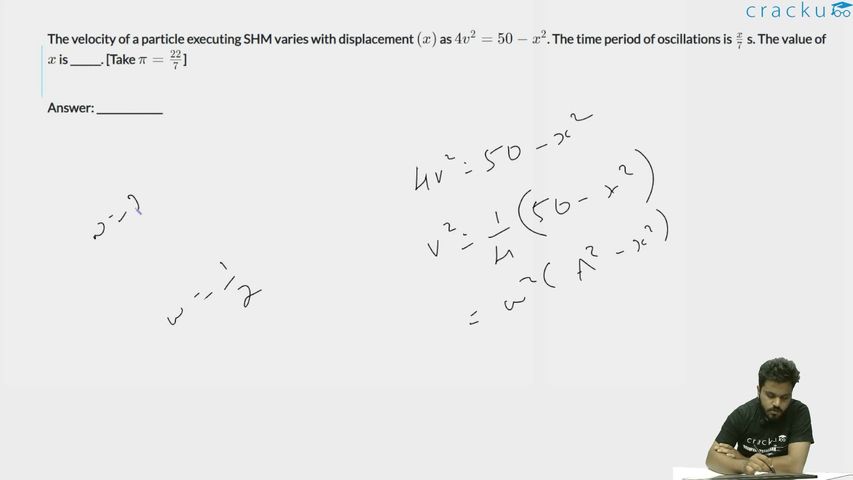
The velocity of a particle executing SHM varies with displacement $$(x)$$ as $$4v^2 = 50 - x^2$$. The time period of oscillations is $$\frac{x}{7}$$ s. The value of $$x$$ is ______. [Take $$\pi = \frac{22}{7}$$]
Correct Answer: 88
For a particle executing Simple Harmonic Motion (SHM), the standard mathematical relation between its instantaneous velocity ($$v$$) and its displacement ($$x$$) from the equilibrium position is given by:
$$v^2 = \omega^2 (A^2 - x^2)$$
Where:
We are given the specific particle velocity equation in the problem statement:
$$4v^2 = 50 - x^2$$
To align this perfectly with our standard SHM form, we divide both sides of the equation by $$4$$:
$$v^2 = \frac{50 - x^2}{4}$$
$$v^2 = \frac{1}{4} (50 - x^2)$$
By comparing our rearranged equation directly with the standard formula $$v^2 = \omega^2 (A^2 - x^2)$$, we match the coefficients sitting outside the parentheses:
$$\omega^2 = \frac{1}{4}$$
Taking the square root of both sides gives the angular frequency:
$$\omega = \sqrt{\frac{1}{4}} = \frac{1}{2} \,\, \text{rad/s}$$
The standard relationship linking the total time period of oscillation ($$T$$) to the angular frequency ($$\omega$$) is:
$$T = \frac{2\pi}{\omega}$$
Substitute our calculated value of $$\omega = \frac{1}{2}$$ into this relationship:
$$T = \frac{2\pi}{\frac{1}{2}} = 4\pi \,\, \text{s}$$
We are instructed to take the approximation value $$\pi = \frac{22}{7}$$:
$$T = 4 \times \left(\frac{22}{7}\right) = \frac{88}{7} \,\, \text{s}$$
The problem states that the time period of oscillation is expressionally equal to $$\frac{x}{7} \,\, \text{s}$$. Comparing the two fraction representations directly:
$$\frac{x}{7} = \frac{88}{7} \implies x = 88$$
Correct Numerical Answer: 88
Was this solution helpful?
Click on the Email ☝️ to Watch the Video Solution
Create a FREE account and get:
_1.webp)

Educational materials for JEE preparation

Ask our AI anything

AI can make mistakes. Please verify important information.
AI can make mistakes. Please verify important information.
