
Join Our JEE Preparation Group
Prep with like-minded aspirants; Get access to free daily tests and study material.
Sign in
Please select an account to continue using cracku.in
↓ →
Join Our JEE Preparation Group
Prep with like-minded aspirants; Get access to free daily tests and study material.
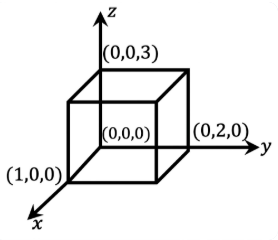
As shown in figure, a cuboid lies in a region with electric field $$E = 2x^2\hat{i} - 4y\hat{j} + 6\hat{k}$$ N C$$^{-1}$$. The magnitude of charge within the cuboid is $$n\varepsilon_0$$ C. The value of $$n$$ is ______ (if dimension of cuboid is $$1 \times 2 \times 3$$ m$$^3$$)
Correct Answer: 12
Use Gauss’s law in differential form:
$$\nabla\cdot\vec{E}=\frac{\rho}{\varepsilon_0}$$
and total charge enclosed
$$Q=ε_0∭(∇⋅E⃗)dV$$
Given
$$E = 2x^2\hat{i} - 4y\hat{j} + 6\hat{k}$$ N C$$^{-1}$$.
Divergence is
$$\nabla\cdot\vec{E}=\frac{\partial(2x^2)}{\partial x}+\frac{\partial(-4y)}{\partial y}+\frac{\partial(6)}{\partial z}$$
$$=4x−4+0$$
$$=4x−4$$
Now cuboid dimensions from figure:
$$0\le x\le1$$
$$0\le y\le2$$
$$0\le z\le3$$
So
$$Q=ε_0\int\int\int(4x−4)dzdydx$$
First integrate over z:
$$=ε_0\int\int3(4x−4)dydx$$
Integrate over y:
$$=ε_0\int6(4x−4)dx$$
$$=6\varepsilon_0\int_0^1(4x-4)dx$$
$$=6\varepsilon_0\left(2x^2-4x\right)_0^1$$
$$=6\varepsilon_0(2-4)$$
$$=-12\varepsilon_0$$
Magnitude of charge:
$$|Q|=12\varepsilon_0$$
Was this solution helpful?
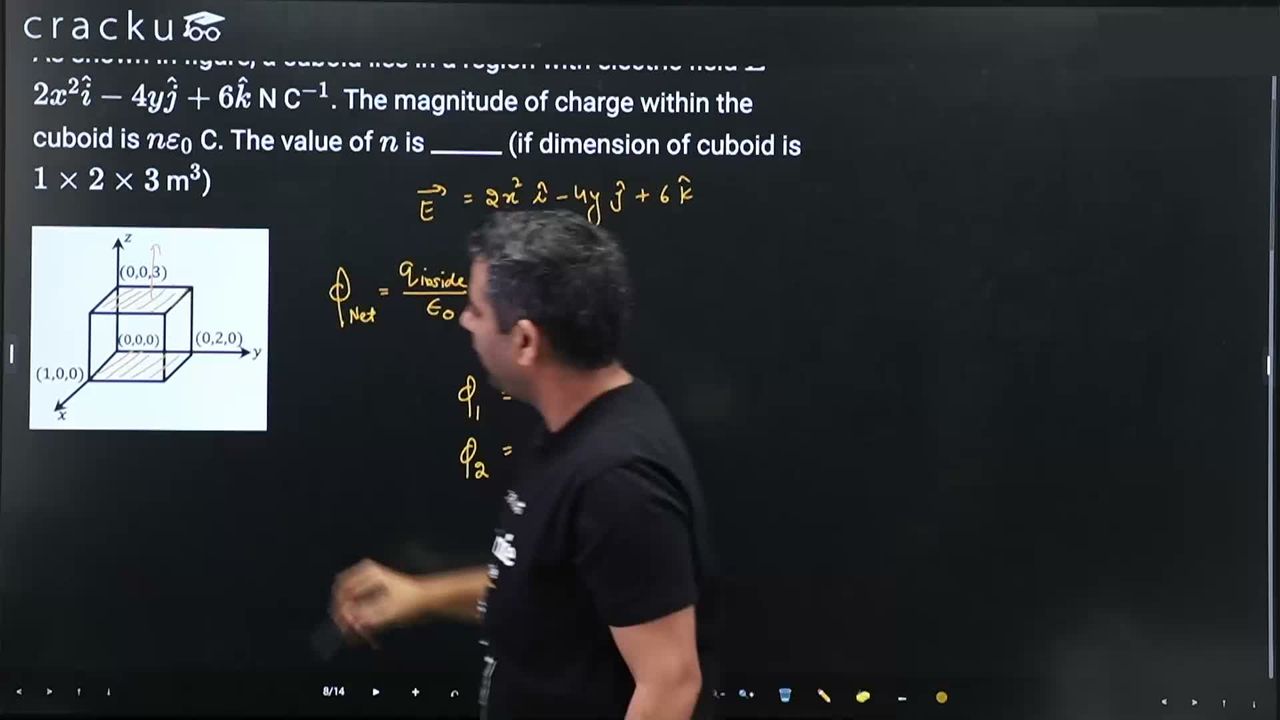
Click on the Email ☝️ to Watch the Video Solution
Create a FREE account and get:
_1.webp)

Educational materials for JEE preparation

Ask our AI anything

AI can make mistakes. Please verify important information.
AI can make mistakes. Please verify important information.
