
Join Our JEE Preparation Group
Prep with like-minded aspirants; Get access to free daily tests and study material.
Sign in
Please select an account to continue using cracku.in
↓ →
Join Our JEE Preparation Group
Prep with like-minded aspirants; Get access to free daily tests and study material.
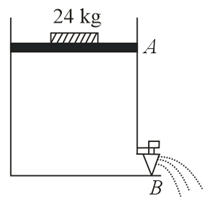
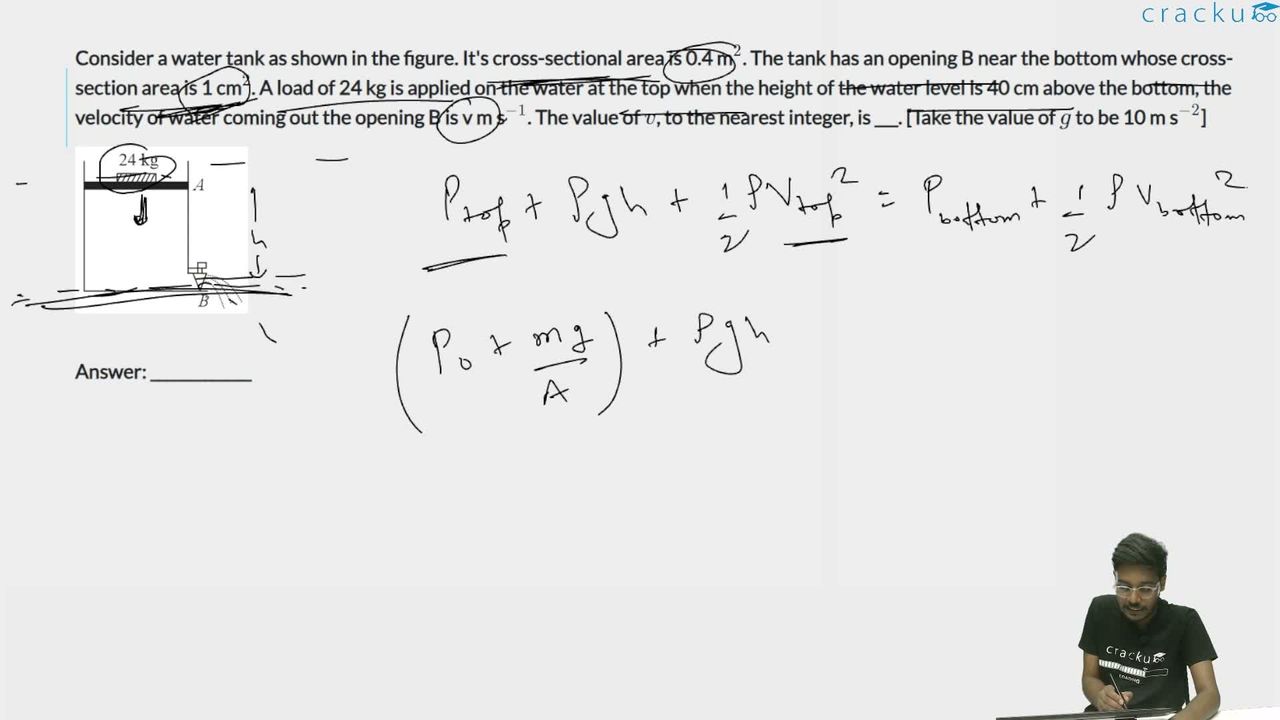
Consider a water tank as shown in the figure. It's cross-sectional area is 0.4 m$$^2$$. The tank has an opening B near the bottom whose cross-section area is 1 cm$$^2$$. A load of 24 kg is applied on the water at the top when the height of the water level is 40 cm above the bottom, the velocity of water coming out the opening B is v m s$$^{-1}$$. The value of $$v$$, to the nearest integer, is ___. [Take the value of $$g$$ to be 10 m s$$^{-2}$$]
Correct Answer: 3
We need to find the velocity $$v$$ of water coming out of the opening $$B$$ near the bottom of the tank.
From the problem statement, we have the following parameters:
Since the top cross-sectional area ($$A = 0.4\text{ m}^2$$) is vastly larger than the opening area ($$a = 10^{-4}\text{ m}^2$$), the velocity of the water level dropping at the top is negligibly close to zero ($$v_{\text{top}} \approx 0$$).
Let's set our reference level at the bottom opening $$B$$ ($$y = 0$$). Applying Bernoulli's equation between the top surface ($$A$$) and the bottom opening ($$B$$):
$$P_{\text{top}} + \rho g h + \frac{1}{2}\rho v_{\text{top}}^2 = P_{\text{bottom}} + \rho g (0) + \frac{1}{2}\rho v^2$$
Where:
Substituting these pressure values and setting $$v_{\text{top}} = 0$$ into the equation gives:
$$\left(P_0 + \frac{Mg}{A}\right) + \rho g h = P_0 + \frac{1}{2}\rho v^2$$
Cancel out the atmospheric pressure ($$P_0$$) from both sides:
$$\frac{Mg}{A} + \rho g h = \frac{1}{2}\rho v^2$$
Isolate $$v^2$$ by multiplying the entire equation by $$\frac{2}{\rho}$$:
$$v^2 = \frac{2Mg}{\rho A} + 2gh$$
Now, plug in the given numerical values:
$$v^2 = \frac{2 \times 24 \times 10}{1000 \times 0.4} + 2 \times 10 \times 0.4$$
$$v^2 = \frac{480}{400} + 8$$
$$v^2 = 1.2 + 8 = 9.2$$
Taking the square root to find $$v$$:
$$v = \sqrt{9.2} \approx 3.03\text{ m s}^{-1}$$
The value of $$v$$ to the nearest integer is 3.
Was this solution helpful?
Click on the Email ☝️ to Watch the Video Solution
Create a FREE account and get:
_1.webp)

Educational materials for JEE preparation

Ask our AI anything

AI can make mistakes. Please verify important information.
AI can make mistakes. Please verify important information.
