
Join Our JEE Preparation Group
Prep with like-minded aspirants; Get access to free daily tests and study material.
Sign in
Please select an account to continue using cracku.in
↓ →
Join Our JEE Preparation Group
Prep with like-minded aspirants; Get access to free daily tests and study material.
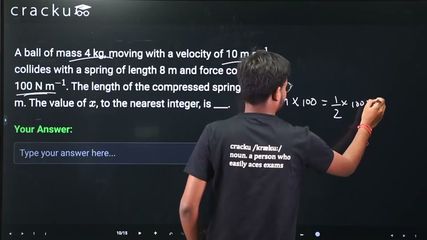
A ball of mass 4 kg, moving with a velocity of 10 m s$$^{-1}$$, collides with a spring of length 8 m and force constant 100 N m$$^{-1}$$. The length of the compressed spring is $$x$$ m. The value of $$x$$, to the nearest integer, is ___.
Correct Answer: 6
When the ball collides with the spring and compresses it maximally, all the kinetic energy of the ball is converted into the potential energy stored in the spring. At maximum compression, the ball momentarily comes to rest.
Using energy conservation: $$\frac{1}{2}mv^2 = \frac{1}{2}kx_c^2$$, where $$x_c$$ is the compression of the spring. Substituting the given values: $$\frac{1}{2}(4)(10)^2 = \frac{1}{2}(100)x_c^2$$, which gives $$200 = 50 x_c^2$$, so $$x_c^2 = 4$$ and $$x_c = 2$$ m.
The natural length of the spring is 8 m. After compression by 2 m, the length of the compressed spring is $$x = 8 - 2 = 6$$ m.
The value of $$x$$ is $$6$$.
Was this solution helpful?
Click on the Email ☝️ to Watch the Video Solution
Create a FREE account and get:
_1.webp)

Educational materials for JEE preparation

Ask our AI anything

AI can make mistakes. Please verify important information.
AI can make mistakes. Please verify important information.
