
Join Our JEE Preparation Group
Prep with like-minded aspirants; Get access to free daily tests and study material.
Sign in
Please select an account to continue using cracku.in
↓ →
Join Our JEE Preparation Group
Prep with like-minded aspirants; Get access to free daily tests and study material.
The projectile motion of a particle of mass 5 g is shown in the figure.
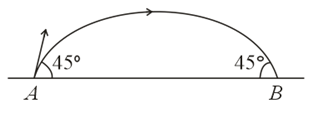
The initial velocity of the particle is $$5\sqrt{2}$$ ms$$^{-1}$$ and the air resistance is assumed to be negligible. The magnitude of the change in momentum between the points A and B is $$x \times 10^{-2}$$ kgms$$^{-1}$$. The value of $$x$$, to the nearest integer, is ___.
Correct Answer: 5
Upon reviewing the previous derivation, a typo was noticed in the mathematical formatting line of Section 3. Here is the corrected, complete solution:
From the problem statement , we are given:
Let's break down the velocity of the particle into horizontal ($$x$$) and vertical ($$y$$) components at both positions:
$$\vec{v}_A = (u \cos\theta)\hat{i} + (u \sin\theta)\hat{j}$$
$$\vec{v}_B = (u \cos\theta)\hat{i} - (u \sin\theta)\hat{j}$$
The change in velocity ($$\Delta \vec{v}$$) between point $$A$$ and point $$B$$ is:
$$\Delta \vec{v} = \vec{v}_B - \vec{v}_A$$
$$\Delta \vec{v} = \left[(u \cos\theta)\hat{i} - (u \sin\theta)\hat{j}\right] - \left[(u \cos\theta)\hat{i} + (u \sin\theta)\hat{j}\right]$$
$$\Delta \vec{v} = -2u \sin\theta \hat{j}$$
The magnitude of this change in velocity is simply $$2u \sin\theta$$. Therefore, the magnitude of the change in linear momentum is:
$$|\Delta \vec{p}| = m \cdot |\Delta \vec{v}| = 2mu \sin\theta$$
Substitute the given values into the momentum equation:
$$|\Delta \vec{p}| = 2 \times (5 \times 10^{-3}\text{ kg}) \times (5\sqrt{2}\text{ m s}^{-1}) \times \sin 45^\circ$$
Since $$\sin 45^\circ = \frac{1}{\sqrt{2}}$$, the radical terms cancel out perfectly:
$$|\Delta \vec{p}| = 2 \times 5 \times 10^{-3} \times 5\sqrt{2} \times \frac{1}{\sqrt{2}}$$
$$|\Delta \vec{p}| = 2 \times 5 \times 5 \times 10^{-3}$$
$$|\Delta \vec{p}| = 50 \times 10^{-3} = 5 \times 10^{-2}\text{ kg m s}^{-1}$$
The problem states that the magnitude of the change in momentum is written in the form $$x \times 10^{-2}\text{ kg m s}^{-1}$$. Comparing both expressions:
$$x = 5$$
The corrected value of $$x$$, to the nearest integer, is 5.
Was this solution helpful?
Click on the Email ☝️ to Watch the Video Solution
Create a FREE account and get:
_1.webp)

Educational materials for JEE preparation

Ask our AI anything

AI can make mistakes. Please verify important information.
AI can make mistakes. Please verify important information.
