
Join Our JEE Preparation Group
Prep with like-minded aspirants; Get access to free daily tests and study material.
Sign in
Please select an account to continue using cracku.in
↓ →
Join Our JEE Preparation Group
Prep with like-minded aspirants; Get access to free daily tests and study material.
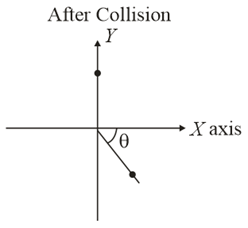
A ball of mass 10 kg moving with a velocity $$10\sqrt{3}$$ m s$$^{-1}$$ along $$X$$-axis, hits another ball of mass 20 kg which is at rest. After the collision, the first ball comes to rest and the second one disintegrates into two equal pieces. One of the pieces starts moving along $$Y$$-axis at a speed of 10 m s$$^{-1}$$. The second piece starts moving at a speed of 20 m s$$^{-1}$$ at an angle $$\theta$$ (degree) with respect to the $$X$$-axis. The configuration of pieces after the collision is shown in the figure. The value of $$\theta$$ to the nearest integer is ________.
Correct Answer: 30
We need to find the value of the angle $$\theta$$ to the nearest integer after a collision between two balls.
Let the first ball have mass $$m_1 = 10\text{ kg}$$ and initial velocity along the $$X$$-axis $$\vec{v}_1 = 10\sqrt{3}\hat{i}\text{ m s}^{-1}$$.
The second ball has mass $$m_2 = 20\text{ kg}$$ and is initially at rest, so $$\vec{v}_2 = 0$$.
The total initial momentum of the system along the $$X$$-axis is: $$P_{initial, x} = m_1 v_1 = 10 \times 10\sqrt{3} = 100\sqrt{3}\text{ kg m s}^{-1}$$.
The total initial momentum of the system along the $$Y$$-axis is: $$P_{initial, y} = 0$$.
After the collision, the first ball comes to rest ($$\vec{v}_1' = 0$$). The second ball disintegrates into two equal pieces of mass $$m = 10\text{ kg}$$ each.
The first piece moves along the positive $$Y$$-axis at a speed of $$10\text{ m s}^{-1}$$. Its momentum vector is: $$\vec{p}_3 = 10 \times 10\hat{j} = 100\hat{j}\text{ kg m s}^{-1}$$.
The second piece moves at a speed of $$20\text{ m s}^{-1}$$ at an angle $$\theta$$ below the $$X$$-axis. Its momentum components are: $$p_{4, x} = m v_4 \cos\theta = 10 \times 20 \cos\theta = 200\cos\theta$$ and $$p_{4, y} = -m v_4 \sin\theta = -10 \times 20 \sin\theta = -200\sin\theta$$.
According to the law of conservation of linear momentum along the $$X$$-axis: $$P_{initial, x} = P_{final, x}$$.
Substituting the values gives: $$100\sqrt{3} = 200\cos\theta$$, which simplifies to: $$\cos\theta = \frac{100\sqrt{3}}{200} = \frac{\sqrt{3}}{2}$$.
According to the law of conservation of linear momentum along the $$Y$$-axis: $$P_{initial, y} = P_{final, y}$$.
Substituting the values gives: $$0 = 100 - 200\sin\theta$$, which simplifies to: $$\sin\theta = \frac{100}{200} = \frac{1}{2}$$.
From both conditions, we find that: $$\theta = 30^\circ$$.
Therefore, the value of $$\theta$$ to the nearest integer is 30.
Click on the Email ☝️ to Watch the Video Solution
Create a FREE account and get:
_1.webp)

Educational materials for JEE preparation

Ask our AI anything

AI can make mistakes. Please verify important information.
AI can make mistakes. Please verify important information.


