
Join Our JEE Preparation Group
Prep with like-minded aspirants; Get access to free daily tests and study material.
Sign in
Please select an account to continue using cracku.in
↓ →
Join Our JEE Preparation Group
Prep with like-minded aspirants; Get access to free daily tests and study material.
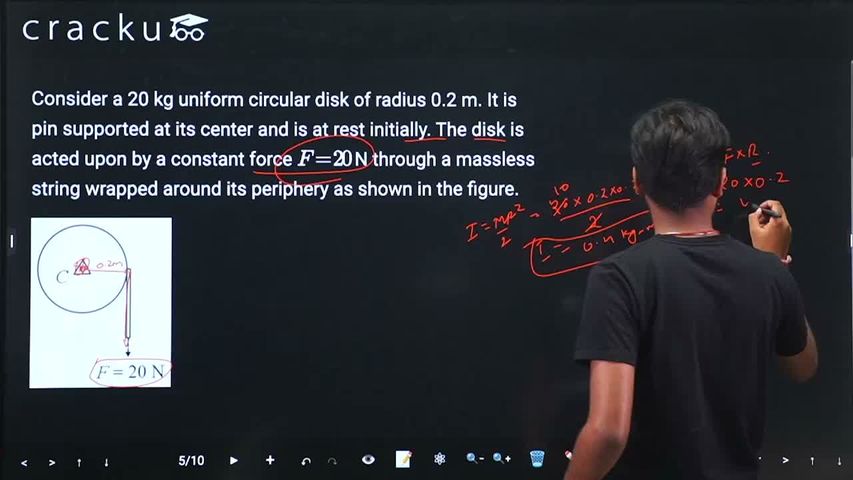
Consider a 20 kg uniform circular disk of radius 0.2 m. It is pin supported at its center and is at rest initially. The disk is acted upon by a constant force $$F = 20$$ N through a massless string wrapped around its periphery as shown in the figure.
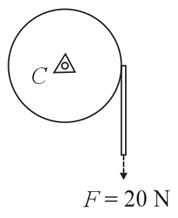
Suppose the disk makes $$n$$ number of revolutions to attain an angular speed of 50 rad s$$^{-1}$$. The value of $$n$$, to the nearest integer, is ________.
[Given: In one complete revolution, the disk rotates by 6.28 rad]
Correct Answer: 20
We need to find the number of revolutions $$n$$ made by a uniform circular disk to reach a given angular speed under the action of a constant force.
The moment of inertia $$I$$ of a uniform circular disk of mass $$M$$ and radius $$R$$ about an axis passing through its center is given by: $$I = \frac{1}{2} M R^2$$.
We are given the following values:
Mass of the disk, $$M = 20\text{ kg}$$
Radius of the disk, $$R = 0.2\text{ m}$$
Substituting these values gives: $$I = \frac{1}{2} \times 20 \times (0.2)^2 = 10 \times 0.04 = 0.4\text{ kg m}^2$$.
The torque $$\tau$$ acting on the disk due to the constant force $$F = 20\text{ N}$$ applied at its periphery is: $$\tau = F \times R = 20 \times 0.2 = 4\text{ N m}$$.
According to Newton's second law for rotation, the angular acceleration $$\alpha$$ is given by: $$\alpha = \frac{\tau}{I} = \frac{4}{0.4} = 10\text{ rad s}^{-2}$$.
The disk starts from rest, so its initial angular speed is $$\omega_0 = 0$$. To find the total angular displacement $$\theta$$ required to attain a final angular speed of $$\omega = 50\text{ rad s}^{-1}$$, we use the third equation of rotational motion: $$\omega^2 = \omega_0^2 + 2\alpha\theta$$.
Substituting the known parameters into the equation yields: $$50^2 = 0^2 + 2 \times 10 \times \theta$$, which simplifies to: $$2500 = 20\theta$$.
Solving for the angular displacement gives: $$\theta = \frac{2500}{20} = 125\text{ rad}$$.
Since one complete revolution corresponds to a rotation of $$6.28\text{ rad}$$, the total number of revolutions $$n$$ is: $$n = \frac{\theta}{2\pi} = \frac{125}{6.28} \approx 19.90$$.
Rounding to the nearest integer, the value of $$n$$ is 20.
Was this solution helpful?
Click on the Email ☝️ to Watch the Video Solution
Create a FREE account and get:
_1.webp)

Educational materials for JEE preparation

Ask our AI anything

AI can make mistakes. Please verify important information.
AI can make mistakes. Please verify important information.
