
Join Our JEE Preparation Group
Prep with like-minded aspirants; Get access to free daily tests and study material.
Sign in
Please select an account to continue using cracku.in
↓ →
Join Our JEE Preparation Group
Prep with like-minded aspirants; Get access to free daily tests and study material.
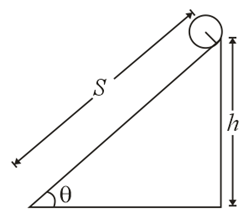
The following bodies, (1) a ring, (2) a disc, (3) a solid cylinder, (4) a solid sphere, of same mass $$m$$ and radius $$R$$ are allowed to roll down without slipping simultaneously from the top of the inclined plane. The body which will reach first at the bottom of the inclined plane is ________. [Mark the body as per their respective numbering given in the question]
Correct Answer: 4
We need to determine which of the four given bodies will reach the bottom of the inclined plane first when allowed to roll down simultaneously without slipping.
When a body rolls down an inclined plane of angle $$\theta$$ without slipping, its linear acceleration ($$a$$) is given by the formula:
$$a = \frac{g \sin\theta}{1 + \frac{I}{mR^2}}$$
Where $$I$$ is the moment of inertia, $$m$$ is the mass, and $$R$$ is the radius of the body.
The body with the highest linear acceleration ($$a$$) will take the least amount of time to travel down the incline, meaning it will reach the bottom first. Looking at the formula, acceleration is inversely proportional to the factor $$\frac{I}{mR^2}$$. Therefore, the body with the smallest value of $$\frac{I}{mR^2}$$ will have the highest acceleration.
Let's calculate the value of $$\frac{I}{mR^2}$$ for each body mentioned on the page:
| Numbering | Body | Moment of Inertia ($$I$$) | $$\frac{I}{mR^2}$$ Value |
|---|---|---|---|
| (1) | Ring | $$mR^2$$ | $$1.00$$ |
| (2) | Disc | $$\frac{1}{2}mR^2$$ | $$0.50$$ |
| (3) | Solid Cylinder | $$\frac{1}{2}mR^2$$ | $$0.50$$ |
| (4) | Solid Sphere | $$\frac{2}{5}mR^2$$ | $$0.40$$ |
$$a_{\text{sphere}} = \frac{g \sin\theta}{1 + 0.4} = \frac{5}{7}g \sin\theta \approx 0.714\, g \sin\theta$$
Since the solid sphere has the maximum linear acceleration, it will reach the bottom of the inclined plane first. This matches numbering 4.
Was this solution helpful?
Click on the Email ☝️ to Watch the Video Solution
Create a FREE account and get:
_1.webp)

Educational materials for JEE preparation

Ask our AI anything

AI can make mistakes. Please verify important information.
AI can make mistakes. Please verify important information.
