
Join Our JEE Preparation Group
Prep with like-minded aspirants; Get access to free daily tests and study material.
Sign in
Please select an account to continue using cracku.in
↓ →
Join Our JEE Preparation Group
Prep with like-minded aspirants; Get access to free daily tests and study material.
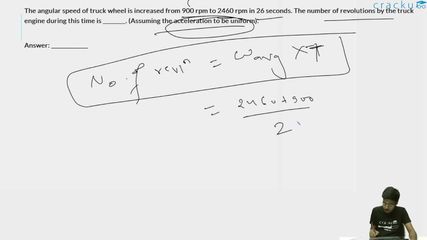
The angular speed of truck wheel is increased from 900 rpm to 2460 rpm in 26 seconds. The number of revolutions by the truck engine during this time is ________. (Assuming the acceleration to be uniform).
Correct Answer: 728
We are given that the angular speed of a truck wheel increases uniformly from $$\omega_1 = 900$$ rpm to $$\omega_2 = 2460$$ rpm in $$t = 26$$ seconds, and we need to find the total number of revolutions during this time.
For uniform angular acceleration, the total angle swept (in revolutions) equals the average angular speed multiplied by the time. The average angular speed is $$\omega_{avg} = \frac{\omega_1 + \omega_2}{2} = \frac{900 + 2460}{2} = \frac{3360}{2} = 1680$$ rpm.
Now we convert the time to minutes: $$t = 26 \text{ seconds} = \frac{26}{60}$$ minutes.
The number of revolutions is $$N = \omega_{avg} \times t = 1680 \times \frac{26}{60} = 1680 \times \frac{13}{30} = \frac{1680 \times 13}{30} = \frac{21840}{30} = 728$$.
Therefore, the number of revolutions by the truck engine during this time is $$\boxed{728}$$.
Was this solution helpful?
Click on the Email ☝️ to Watch the Video Solution
Create a FREE account and get:
_1.webp)

Educational materials for JEE preparation

Ask our AI anything

AI can make mistakes. Please verify important information.
AI can make mistakes. Please verify important information.
