
Join Our JEE Preparation Group
Prep with like-minded aspirants; Get access to free daily tests and study material.
Sign in
Please select an account to continue using cracku.in
↓ →
Join Our JEE Preparation Group
Prep with like-minded aspirants; Get access to free daily tests and study material.
Consider a badminton racket with length scales as shown in the figure.
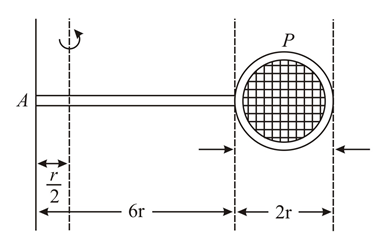
If the mass of the linear and circular portions of the badminton racket are same (M) and the mass of the threads are negligible, the moment of inertia of the racket about an axis perpendicular to the handle and in the plane of the ring at, $$\frac{r}{2}$$ distance from the end A of the handle will be _________ $$Mr^2$$.
Correct Answer: 52
We need to determine the total moment of inertia of the badminton racket about an axis perpendicular to the handle, lying in the plane of the ring, and located at a distance of
$$\frac{r}{2}$$
from the free end A of the handle.
From the problem statement , the badminton racket is split into two geometric components:
The target axis of rotation is positioned at a distance of $$\frac{r}{2}$$ from end A of the handle.
The handle is treated as a uniform thin rod. We determine its moment of inertia using the parallel axis theorem:
$$I_{\text{cm, handle}} = \frac{1}{12} M L^2 = \frac{1}{12} M (6r)^2 = 3Mr^2$$
$$d_1 = 3r - \frac{r}{2} = \frac{5r}{2}$$
Applying the Parallel Axis Theorem ($$I = I_{\text{cm}} + Md^2$$):
$$I_{\text{handle}} = 3Mr^2 + M\left(\frac{5r}{2}\right)^2 = 3Mr^2 + \frac{25}{4}Mr^2 = \frac{37}{4}Mr^2$$
The head of the racket is treated as a uniform circular ring. The rotation axis lies along the coplanar diameter plane of the ring:
$$I_{\text{cm, ring}} = \frac{1}{2}Mr^2$$
$$d_2 = 7r - \frac{r}{2} = \frac{13r}{2}$$
Applying the Parallel Axis Theorem ($$I = I_{\text{cm}} + Md^2$$):
$$I_{\text{ring}} = \frac{1}{2}Mr^2 + M\left(\frac{13r}{2}\right)^2 = \frac{2}{4}Mr^2 + \frac{169}{4}Mr^2 = \frac{171}{4}Mr^2$$
The total moment of inertia of the entire composite racket system is the scalar sum of both individual components:
$$I_{\text{total}} = I_{\text{handle}} + I_{\text{ring}}$$
$$I_{\text{total}} = \frac{37}{4}Mr^2 + \frac{171}{4}Mr^2 = \frac{208}{4}Mr^2 = 52Mr^2$$
The multiplier value for the final total moment of inertia observed for the badminton racket is 52.
Was this solution helpful?
Create a FREE account and get:
_1.webp)

Educational materials for JEE preparation

Ask our AI anything

AI can make mistakes. Please verify important information.
AI can make mistakes. Please verify important information.
