
Join Our JEE Preparation Group
Prep with like-minded aspirants; Get access to free daily tests and study material.
Sign in
Please select an account to continue using cracku.in
↓ →
Join Our JEE Preparation Group
Prep with like-minded aspirants; Get access to free daily tests and study material.
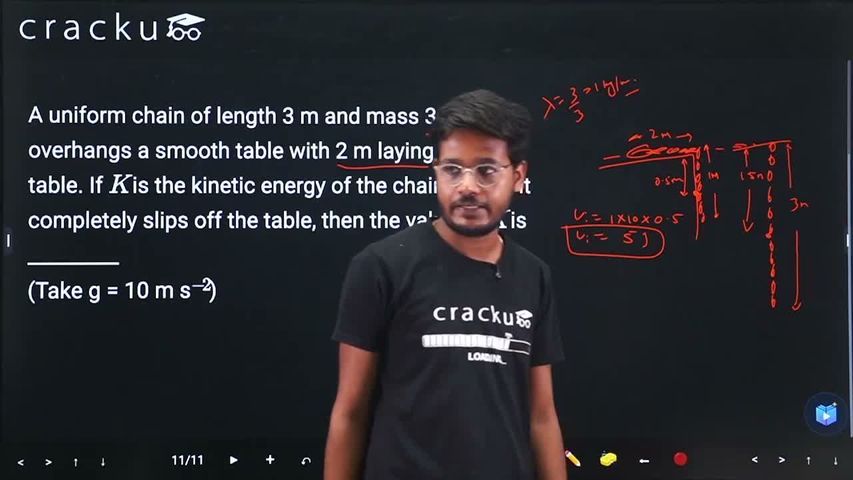
A uniform chain of length 3 m and mass 3 kg overhangs a smooth table with 2 m laying on the table. If $$K$$ is the kinetic energy of the chain in J as it completely slips off the table, then the value of $$K$$ is _________
(Take g = 10 m s$$^{-2}$$)
Correct Answer: 40
We have a uniform chain of total length $$L = 3\ \text{m}$$ and total mass $$M = 3\ \text{kg}$$. Because the chain is uniform, its linear mass density is given by the formula $$\lambda = \dfrac{M}{L}$$. Substituting the given values, $$\lambda = \dfrac{3\ \text{kg}}{3\ \text{m}} = 1\ \text{kg m}^{-1}$$.
At the beginning, $$2\ \text{m}$$ of the chain rests on the smooth table and $$1\ \text{m}$$ overhangs. The mass that is hanging is therefore $$m_{\text{hang}} = \lambda \times 1\ \text{m} = 1\ \text{kg}$$, while the mass on the table is $$m_{\text{table}} = \lambda \times 2\ \text{m} = 2\ \text{kg}$$.
We choose the level of the tabletop as our reference level for gravitational potential energy (GPE). Hence any element of chain that is below the tabletop has negative potential energy.
Initial gravitational potential energy
Only the hanging part contributes because the portion on the table is at the reference level. For a uniform hanging segment of length $$1\ \text{m}$$, its centre of mass lies halfway down, i.e. at a vertical distance $$h_i = 0.5\ \text{m}$$ below the table. The GPE of this part is obtained from the standard formula $$U = m g h$$. Since the height is downward (negative), $$h = -0.5\ \text{m}$$. Thus
$$U_i = m_{\text{hang}}\; g\; h_i = (1\ \text{kg})(10\ \text{m s}^{-2})(-0.5\ \text{m}) = -5\ \text{J}.$$
The portion on the table has $$h = 0$$, so its GPE is zero. Therefore the total initial potential energy of the chain is $$U_i = -5\ \text{J}$$.
Final gravitational potential energy
When the chain has completely slipped off, the whole length $$3\ \text{m}$$ hangs vertically. For any uniform body, the centre of mass lies at its midpoint. Hence the centre of mass is now at a distance $$h_f = 1.5\ \text{m}$$ below the tabletop, i.e. $$h_f = -1.5\ \text{m}$$. Applying the same formula,
$$U_f = M g h_f = (3\ \text{kg})(10\ \text{m s}^{-2})(-1.5\ \text{m}) = -45\ \text{J}.$$
Change in potential energy
The change is
$$\Delta U = U_f - U_i = (-45\ \text{J}) - (-5\ \text{J}) = -40\ \text{J}.$$
The negative sign means the chain has lost $$40\ \text{J}$$ of gravitational potential energy.
The table is smooth, so there is no friction and hence no non-conservative work. By conservation of mechanical energy, the loss in potential energy equals the gain in kinetic energy. Therefore,
$$K = -\Delta U = 40\ \text{J}.$$
Hence, the correct answer is Option 40.
Was this solution helpful?
Click on the Email ☝️ to Watch the Video Solution
Create a FREE account and get:
_1.webp)

Educational materials for JEE preparation

Ask our AI anything

AI can make mistakes. Please verify important information.
AI can make mistakes. Please verify important information.
