
Join Our JEE Preparation Group
Prep with like-minded aspirants; Get access to free daily tests and study material.
Sign in
Please select an account to continue using cracku.in
↓ →
Join Our JEE Preparation Group
Prep with like-minded aspirants; Get access to free daily tests and study material.
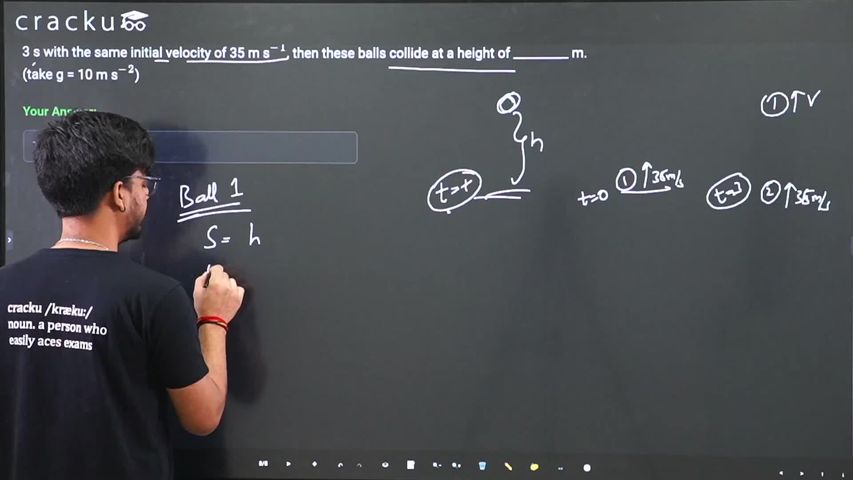
Two spherical balls having equal masses with radius of 5 cm each are thrown upwards along the same vertical direction at an interval of 3 s with the same initial velocity of 35 m s$$^{-1}$$, then these balls collide at a height of _________ m.
(take g = 10 m s$$^{-2}$$)
Correct Answer: 50
Let us denote the instant when the first ball is projected upward as $$t = 0$$. Its initial velocity is given as $$u = 35\ \text{m s}^{-1}$$ and it moves against gravity whose magnitude is $$g = 10\ \text{m s}^{-2}$$ (acting downward).
The vertical displacement of any body projected upward with initial speed $$u$$ under constant downward acceleration $$g$$, after a time $$t$$, is given by the well-known kinematic relation
$$s = ut - \tfrac12 g t^{2}.$$
We apply this formula separately to the two balls.
For the first ball, the time elapsed since its launch is simply $$t$$ seconds. Hence its height above the point of projection is
$$\begin{aligned} y_{1} &= u t - \tfrac12 g t^{2} \\ &= 35\,t - 5\,t^{2}. \quad -(1) \end{aligned}$$
The second ball is thrown upward exactly $$3\ \text{s}$$ after the first one. Therefore, when the clock shows $$t$$ seconds after the first throw, the second ball has been in flight for only $$(t-3)$$ seconds. (Of course, this expression is meaningful only when $$t \ge 3\ \text{s}$$, i.e. after the second ball has actually been launched.) Using the same formula, its height is
$$\begin{aligned} y_{2} &= u\,(t-3) - \tfrac12 g\,(t-3)^{2} \\ &= 35\,(t-3) - 5\,(t-3)^{2}. \quad -(2) \end{aligned}$$
The collision occurs when both balls are at the same height, so we set $$y_{1} = y_{2}$$ using equations (1) and (2).
$$\begin{aligned} 35\,t - 5\,t^{2} &= 35\,(t-3) - 5\,(t-3)^{2}. \end{aligned}$$
First we expand the right-hand side:
$$\begin{aligned} 35\,(t-3) &= 35t - 105,\\ (t-3)^{2} &= t^{2} - 6t + 9,\\ -5\,(t-3)^{2} &= -5t^{2} + 30t - 45. \end{aligned}$$
Adding these components, the right-hand side becomes
$$\bigl(35t -105\bigr) + \bigl(-5t^{2} + 30t - 45\bigr) = 65t - 5t^{2} - 150.$$
Equating both sides we have
$$35t - 5t^{2} = 65t - 5t^{2} - 150.$$
The terms $$-5t^{2}$$ appear on both sides and cancel out immediately, leaving
$$35t = 65t - 150.$$
Transposing the terms gives
$$35t - 65t = -150 \quad\Longrightarrow\quad -30t = -150.$$
Dividing by $$-30$$ we find
$$t = 5\ \text{s}.$$
Thus, the collision happens $$5\ \text{s}$$ after the first ball was projected, which also means $$5 - 3 = 2\ \text{s}$$ after the second ball was projected.
To obtain the height at which they meet, we substitute $$t = 5\ \text{s}$$ into equation (1) (the expression for the first ball, though either expression would give the same result):
$$\begin{aligned} y &= 35\,(5) - 5\,(5)^{2} \\ &= 175 - 5 \times 25 \\ &= 175 - 125 \\ &= 50\ \text{m}. \end{aligned}$$
Therefore, the two spherical balls collide at a height of $$50\ \text{m}$$ above the point of projection.
So, the answer is $$50\ \text{m}.$$
Was this solution helpful?
Click on the Email ☝️ to Watch the Video Solution
Create a FREE account and get:
_1.webp)

Educational materials for JEE preparation

Ask our AI anything

AI can make mistakes. Please verify important information.
AI can make mistakes. Please verify important information.
