
Join Our JEE Preparation Group
Prep with like-minded aspirants; Get access to free daily tests and study material.
Sign in
Please select an account to continue using cracku.in
↓ →
Join Our JEE Preparation Group
Prep with like-minded aspirants; Get access to free daily tests and study material.
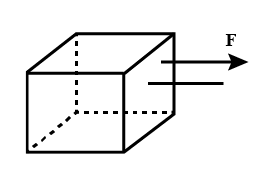
Consider a uniform cubical box of side a on a rough floor that is to be moved by applying minimum possible force F at a point b above its centre of mass (see figure). If the coefficient of friction is $$\mu = 0.4$$, the maximum possible value of $$100 \times \frac{b}{a}$$ for a box not to topple before moving is
Correct Answer: 50
Minimum Required Theory
Step-by-Step Solution
Step 1: Determine the minimum force for sliding
For the box to just start moving:
$$F = \mu mg$$
Step 2: Set up the torque inequality for "No Toppling"
Calculate the torques about the bottom front edge.
For the box not to topple:
$$F\left(\frac{a}{2} + b\right) \le mg\left(\frac{a}{2}\right)$$
Step 3: Solve the mathematical inequality for $$b$$
Substitute $$F = \mu mg$$ into the torque equation:
$$\mu mg\left(\frac{a}{2} + b\right) \le mg\left(\frac{a}{2}\right)$$
Cancel $$mg$$ from both sides:
$$\mu\left(\frac{a}{2} + b\right) \le \frac{a}{2}$$
Substitute the given coefficient of friction ($$\mu = 0.4$$):
$$0.4\left(0.5a + b\right) \le 0.5a$$
$$0.2a + 0.4b \le 0.5a$$
$$0.4b \le 0.3a$$
$$b \le 0.75a$$
Mathematical Conclusion: To avoid toppling, $$b$$ can be up to $$0.75a$$.
Step 4: Apply the physical geometric constraint
Since $$0.5a$$ is smaller than the limiting mathematical value of $$0.75a$$, the geometry dictates the maximum limit:
$$b_{max} = 0.5a$$
Step 5: Calculate the final requested value
The question asks for the maximum possible value of $$100 \times \frac{b}{a}$$.
$$\frac{b}{a} = 0.5$$
$$100 \times \left(\frac{b}{a}\right) = 100 \times 0.5 = 50$$
Final Answer: 50
Was this solution helpful?
Click on the Email ☝️ to Watch the Video Solution
Create a FREE account and get:
_1.webp)

Educational materials for JEE preparation

Ask our AI anything

AI can make mistakes. Please verify important information.
AI can make mistakes. Please verify important information.
