
Join Our JEE Preparation Group
Prep with like-minded aspirants; Get access to free daily tests and study material.
Sign in
Please select an account to continue using cracku.in
↓ →
Join Our JEE Preparation Group
Prep with like-minded aspirants; Get access to free daily tests and study material.
In the circuit shown here, the point 'C' is kept connected to point 'A' till the current flowing through the circuit becomes constant. Afterward, suddenly, point 'C' is disconnected from point 'A' and connected to point 'B' at time $$t = 0$$. Ratio of the voltage across resistance and the inductor at $$t = \frac{L}{R}$$ will be equal to:
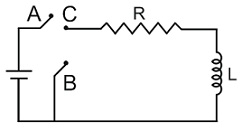
When point 'C' is connected to point 'B', the battery is completely disconnected from the loop. The circuit becomes a closed, source-free series $$RL$$ circuit containing only the resistor $$R$$ and the inductor $$L$$. Applying Kirchhoff's Voltage Law ($$\text{KVL}$$) around this closed loop at any time $$t \ge 0$$: $$V_R + V_L = 0$$
($$V_R$$ is the voltage across the resistance and $$V_L$$ is the voltage across the inductor).
$$V_R = -V_L$$
$$\frac{V_R}{V_L} = -1$$
Since this relationship holds true by $$\text{KVL}$$ at all time instances $$t \ge 0$$, it is independent of the specific time value. Therefore, at $$t = \frac{L}{R}$$, the ratio remains exactly $$-1$$.
Was this solution helpful?
Create a FREE account and get:
_1.webp)

Educational materials for JEE preparation

Ask our AI anything

AI can make mistakes. Please verify important information.
AI can make mistakes. Please verify important information.
