
Join Our JEE Preparation Group
Prep with like-minded aspirants; Get access to free daily tests and study material.
Sign in
Please select an account to continue using cracku.in
↓ →
Join Our JEE Preparation Group
Prep with like-minded aspirants; Get access to free daily tests and study material.
In the circuit, the logical value of $$A = 1$$ or $$B = 1$$ when potential at $$A$$ or $$B$$ is $$5 \text{ V}$$ and the logical value of $$A = 0$$ or $$B = 0$$ when potential at $$A$$ or $$B$$ is $$0 \text{ V}$$.
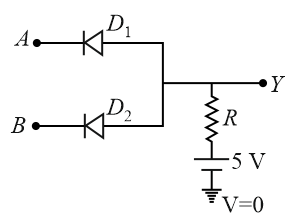
The truth table of the given circuit will be:
We need to determine the correct truth table for the given diode logic circuit.
From the schematic :
The circuit behaves exactly like a standard digital AND gate:
| $$A$$ | $$B$$ | $$Y$$ |
|---|---|---|
| 0 | 0 | 0 |
| 1 | 0 | 0 |
| 0 | 1 | 0 |
| 1 | 1 | 1 |
The truth table corresponds directly to Option A.
Was this solution helpful?
Create a FREE account and get:
_1.webp)

Educational materials for JEE preparation

Ask our AI anything

AI can make mistakes. Please verify important information.
AI can make mistakes. Please verify important information.
