
Join Our JEE Preparation Group
Prep with like-minded aspirants; Get access to free daily tests and study material.
Sign in
Please select an account to continue using cracku.in
↓ →
Join Our JEE Preparation Group
Prep with like-minded aspirants; Get access to free daily tests and study material.
A car is moving with speed of $$150 \text{ km h}^{-1}$$ and after applying the brake it will move $$27 \text{ m}$$ before it stops. If the same car is moving with a speed of one third the reported speed then it will stop after travelling ______ m distance.
Correct Answer: 3
We use the kinematic equation relating velocity, acceleration, and distance:
$$v^2 = u^2 + 2as$$
When the car stops, $$v = 0$$, so:
$$0 = u^2 + 2as \implies s = \dfrac{u^2}{2|a|}$$
This shows that the stopping distance is proportional to the square of the initial speed:
$$s \propto u^2$$
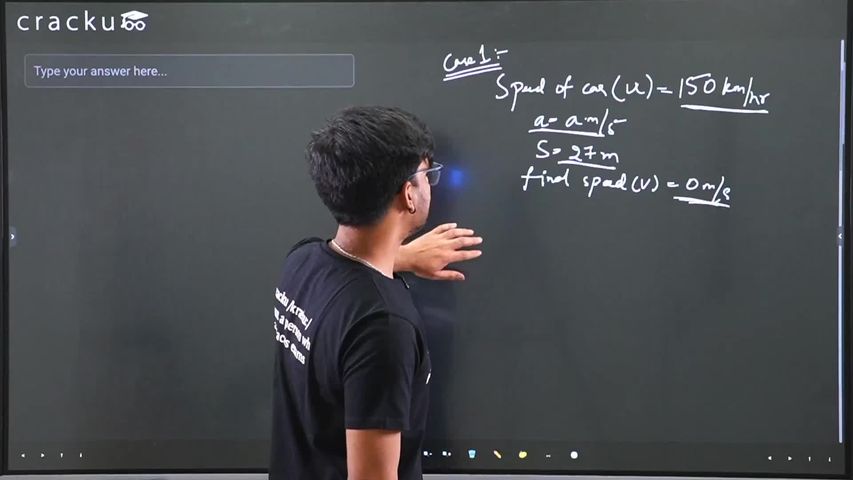
Case 1: Speed $$u_1 = 150 \text{ km h}^{-1}$$, stopping distance $$s_1 = 27 \text{ m}$$.
Case 2: Speed $$u_2 = \dfrac{u_1}{3} = 50 \text{ km h}^{-1}$$, stopping distance $$s_2 = ?$$
Since the braking force (and hence deceleration) is the same in both cases:
$$\dfrac{s_2}{s_1} = \dfrac{u_2^2}{u_1^2} = \left(\dfrac{1}{3}\right)^2 = \dfrac{1}{9}$$
$$s_2 = \dfrac{27}{9} = 3 \text{ m}$$
Therefore, the car will stop after travelling $$\boxed{3}$$ m.
Was this solution helpful?
Click on the Email ☝️ to Watch the Video Solution
Create a FREE account and get:
_1.webp)

Educational materials for JEE preparation

Ask our AI anything

AI can make mistakes. Please verify important information.
AI can make mistakes. Please verify important information.
