
Join Our JEE Preparation Group
Prep with like-minded aspirants; Get access to free daily tests and study material.
Sign in
Please select an account to continue using cracku.in
↓ →
Join Our JEE Preparation Group
Prep with like-minded aspirants; Get access to free daily tests and study material.
A charge q is spread uniformly over an insulated loop of radius r. If it is rotated with an angular velocity $$\omega$$ with respect to normal axis then magnetic moment of the loop is:
The total charge $$q$$ is uniformly distributed over a thin circular ring of radius $$r$$. When the ring rotates as a rigid body about its own normal (central) axis with constant angular velocity $$\omega$$, every element of charge makes one complete revolution in the same time. Hence the entire charge $$q$$ effectively behaves as if it were a single lump of charge completing one full circle every time period $$T$$.
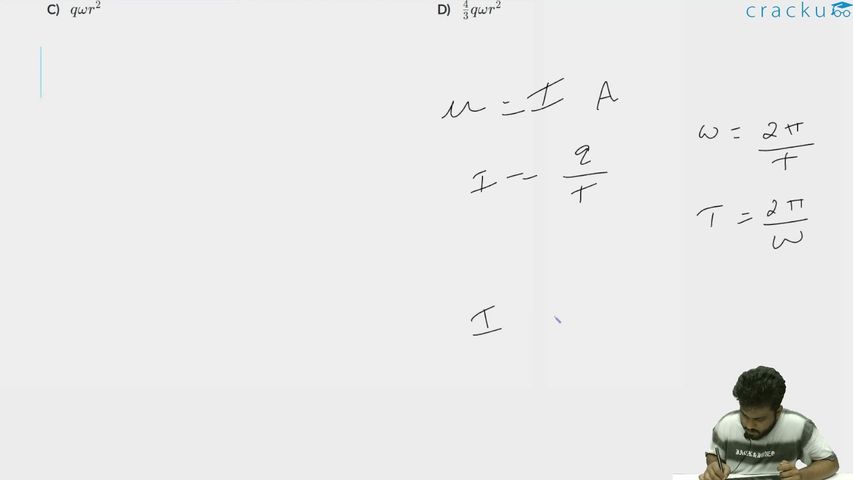
For uniform circular motion the relation between angular velocity and time period is first stated:
$$\displaystyle T=\frac{2\pi}{\omega}.$$
Electric current is defined as charge per unit time. Therefore, applying the definition,
$$I=\frac{q}{T}$$, i.e. total charge passing a fixed point in one revolution divided by the time for one revolution.
Substituting the expression for $$T$$ from the earlier step, we get
$$\displaystyle I=\frac{q}{\dfrac{2\pi}{\omega}}=q\left(\frac{\omega}{2\pi}\right)=\frac{q\omega}{2\pi}.$$
Now we recall the formula for the magnetic moment of a current loop. For a single-turn loop,
$$\displaystyle \mu = I\,A,$$
where $$A$$ is the area enclosed by the loop. Since the loop is a circle of radius $$r$$, its area is
$$\displaystyle A=\pi r^{2}.$$
Substituting the expressions for $$I$$ and $$A$$ into the formula for $$\mu$$, we obtain
$$\mu = \left(\frac{q\omega}{2\pi}\right)\,(\pi r^{2}).$$
We note that the factor $$\pi$$ in the numerator and the denominator cancels, leaving
$$\displaystyle \mu = \frac{q\omega r^{2}}{2}.$$
Thus the magnetic moment of the rotating charged ring is
$$\boxed{\displaystyle \mu = \frac{1}{2}\,q\,\omega\,r^{2}}.$$
Hence, the correct answer is Option B.
Was this solution helpful?
Click on the Email ☝️ to Watch the Video Solution
Create a FREE account and get:
_1.webp)

Educational materials for JEE preparation

Ask our AI anything

AI can make mistakes. Please verify important information.
AI can make mistakes. Please verify important information.
