
Join Our JEE Preparation Group
Prep with like-minded aspirants; Get access to free daily tests and study material.
Sign in
Please select an account to continue using cracku.in
↓ →
Join Our JEE Preparation Group
Prep with like-minded aspirants; Get access to free daily tests and study material.
A modern grand-prix racing car of mass $$m$$ is travelling on a flat track in a circular arc of radius $$R$$ with a speed $$v$$. If the coefficient of static friction between the tyres and the track is $$\mu_s$$, then the magnitude of negative lift $$F_L$$ acting downwards on the car is:
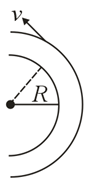
We need to determine the magnitude of the downward negative lift $$F_L$$ acting on a racing car moving along a flat circular track.
From the problem statement on the page, the car is moving in a horizontal circle of radius $$R$$ with a speed $$v$$. Let's analyze the forces acting in both vertical and horizontal directions:
$$N = mg + F_L \quad \text{--- (Equation 1)}$$
$$f_s = \frac{m v^2}{R}$$
To safely navigate the turn at speed $$v$$, the required centripetal friction must be provided by the maximum limiting static friction available ($$f_s = \mu_s N$$):
$$\mu_s N = \frac{m v^2}{R}$$
Solving for the normal force $$N$$ gives:
$$N = \frac{m v^2}{\mu_s R} \quad \text{--- (Equation 2)}$$
Now, equate Equation 1 and Equation 2 to eliminate $$N$$:
$$mg + F_L = \frac{m v^2}{\mu_s R}$$
Isolate the negative lift force $$F_L$$:
$$F_L = \frac{m v^2}{\mu_s R} - mg$$
Factoring out the mass $$m$$ from both terms yields the final expression:
$$F_L = m \left( \frac{v^2}{\mu_s R} - g \right)$$
The magnitude of the negative lift acting downwards on the car is $$m \left( \frac{v^2}{\mu_s R} - g \right)$$, which corresponds to Option B.
Was this solution helpful?
Create a FREE account and get:
_1.webp)

Educational materials for JEE preparation

Ask our AI anything

AI can make mistakes. Please verify important information.
AI can make mistakes. Please verify important information.
