
Join Our JEE Preparation Group
Prep with like-minded aspirants; Get access to free daily tests and study material.
Sign in
Please select an account to continue using cracku.in
↓ →
Join Our JEE Preparation Group
Prep with like-minded aspirants; Get access to free daily tests and study material.
A car accelerates from rest at a constant rate $$\alpha$$ for some time after which it decelerates at a constant rate $$\beta$$ to come to rest. If the total time elapsed is $$t$$ seconds, the total distance travelled is:
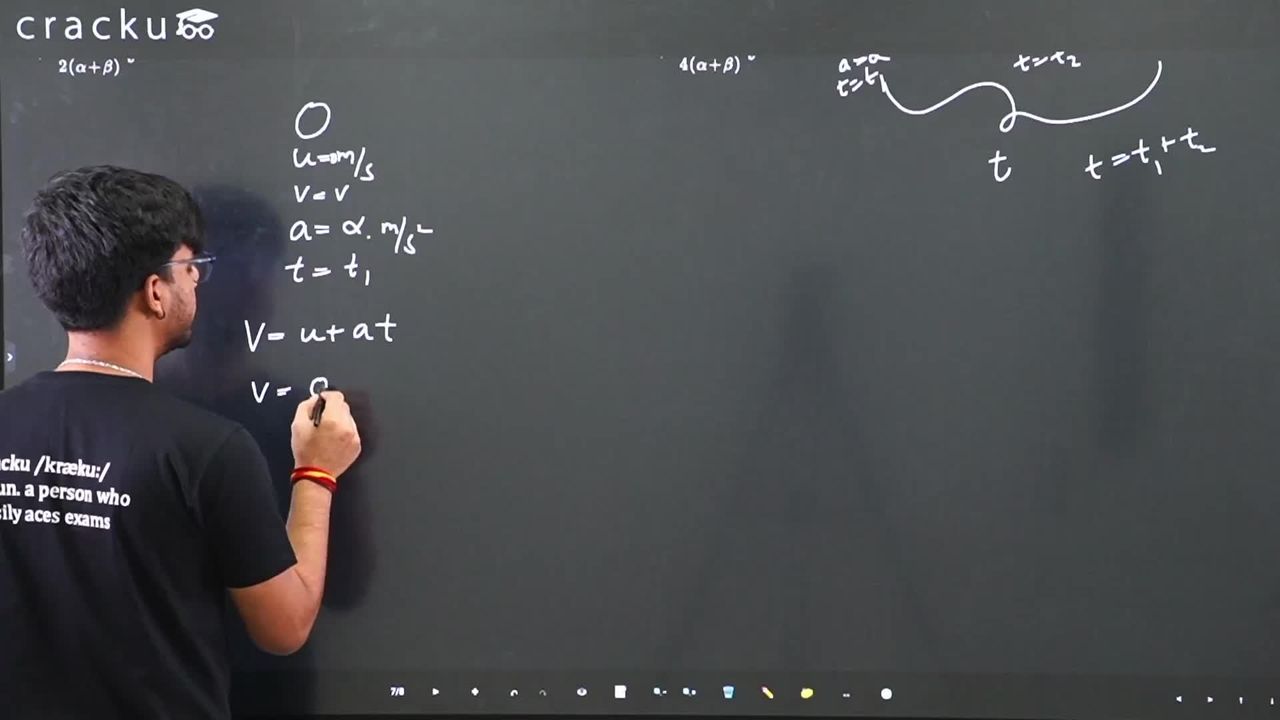
Let the car accelerate at rate $$\alpha$$ for time $$t_1$$ and then decelerate at rate $$\beta$$ for time $$t_2$$. Since the car starts and ends at rest, the maximum velocity reached is $$v = \alpha t_1 = \beta t_2$$. Also, $$t_1 + t_2 = t$$.
From $$v = \alpha t_1$$ and $$v = \beta t_2$$, we get $$t_1 = \frac{v}{\alpha}$$ and $$t_2 = \frac{v}{\beta}$$. Substituting into $$t_1 + t_2 = t$$ gives $$\frac{v}{\alpha} + \frac{v}{\beta} = t$$, so $$v\left(\frac{\alpha + \beta}{\alpha\beta}\right) = t$$, which means $$v = \frac{\alpha\beta t}{\alpha + \beta}$$.
The total distance is the sum of distances during acceleration and deceleration: $$S = \frac{1}{2}\alpha t_1^2 + \frac{1}{2}\beta t_2^2 = \frac{v^2}{2\alpha} + \frac{v^2}{2\beta} = \frac{v^2}{2}\left(\frac{1}{\alpha} + \frac{1}{\beta}\right) = \frac{v^2}{2} \cdot \frac{\alpha + \beta}{\alpha\beta}$$.
Substituting $$v = \frac{\alpha\beta t}{\alpha + \beta}$$ yields $$S = \frac{1}{2} \cdot \frac{\alpha^2\beta^2 t^2}{(\alpha+\beta)^2} \cdot \frac{\alpha+\beta}{\alpha\beta} = \frac{\alpha\beta t^2}{2(\alpha+\beta)}$$.
The correct answer is option 3: $$\frac{\alpha\beta}{2(\alpha+\beta)}t^2$$.
Was this solution helpful?
Click on the Email ☝️ to Watch the Video Solution
Create a FREE account and get:
_1.webp)

Educational materials for JEE preparation

Ask our AI anything

AI can make mistakes. Please verify important information.
AI can make mistakes. Please verify important information.
