
Join Our JEE Preparation Group
Prep with like-minded aspirants; Get access to free daily tests and study material.
Sign in
Please select an account to continue using cracku.in
↓ →
Join Our JEE Preparation Group
Prep with like-minded aspirants; Get access to free daily tests and study material.
A block of mass $$m = 1$$ kg slides with velocity $$v = 6$$ m s$$^{-1}$$ on a frictionless horizontal surface and collides with a uniform vertical rod and sticks to it as shown. The rod is pivoted about O and swings as a result of the collision making angle $$\theta$$ before momentarily coming to rest. If the rod has mass $$M = 2$$ kg, and length $$\ell = 1$$ m, the value of $$\theta$$ is approximately (take $$g = 10$$ m s$$^{-2}$$)
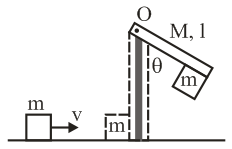
Moment of inertia of the rod-and-block system about pivot O:
$$I = I_{\text{rod}} + I_{\text{block}} = \frac{1}{3}Ml^2 + ml^2$$
$$I = \frac{1}{3}(2)(1)^2 + (1)(1)^2 = \frac{2}{3} + 1 = \frac{5}{3}\ \text{kg m}^2$$
Conservation of angular momentum about pivot O during collision:
$$L_i = L_f \implies mvl = I\omega$$
$$(1)(6)(1) = \frac{5}{3}\omega \implies \omega = \frac{18}{5} = 3.6\ \text{rad s}^{-1}$$
Conservation of mechanical energy after collision:
$$K_f = \Delta U \implies \frac{1}{2}I\omega^2 = Mgh_{\text{cm, rod}} + mgh_{\text{block}}$$
Height gained by the rod's centre of mass and the block:
$$h_{\text{cm, rod}} = \frac{l}{2}(1 - \cos\theta)$$
$$h_{\text{block}} = l(1 - \cos\theta)$$
$$\frac{1}{2}I\omega^2 = \left[M\frac{l}{2} + ml\right]g(1 - \cos\theta)$$
$$\frac{1}{2}\left(\frac{5}{3}\right)(3.6)^2 = \left[2\left(\frac{1}{2}\right) + 1(1)\right](10)(1 - \cos\theta)$$
$$\frac{5}{6}(12.96) = (1 + 1)(10)(1 - \cos\theta)$$
$$10.8 = 20(1 - \cos\theta)$$
$$1 - \cos\theta = \frac{10.8}{20} = 0.54 \implies \cos\theta = 0.46$$
$$\theta = \cos^{-1}(0.46) \approx 62.6^\circ \approx 63^\circ$$
Was this solution helpful?
Create a FREE account and get:
_1.webp)

Educational materials for JEE preparation

Ask our AI anything

AI can make mistakes. Please verify important information.
AI can make mistakes. Please verify important information.
