Join WhatsApp Icon JEE WhatsApp Group
Question 18

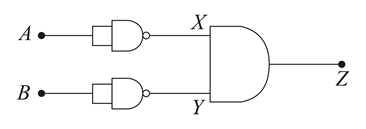
Identify the logic operation carried out by the given circuit:

We need to determine the equivalent logic operation carried out by the given digital circuit arrangement.


1. Identify the Component Logic Gates

From the schematic layout, the circuit consists of three logic gates connected in series:

  • Input Gates: Two single-input NAND gates acting as NOT gates for inputs $$A$$ and $$B$$.
  • Output Gate: One two-input AND gate that combines the intermediate signals to produce output $$Z$$.

2. Analyze Intermediate Outputs ($$X$$ and $$Y$$)

When both input terminals of a NAND gate are shorted together, it functions strictly as an inverter (NOT gate):

  • Upper Channel:
    Input $$A$$ passes through the shorted NAND gate, giving intermediate output $$X$$:

    $$X = \bar{A}$$

  • Lower Channel:
    Input $$B$$ passes through the shorted NAND gate, giving intermediate output $$Y$$:

    $$Y = \bar{B}$$


3. Determine the Final Output Expression ($$Z$$)

The signals $$X$$ and $$Y$$ serve as inputs to the final AND gate. The Boolean expression for the final output $$Z$$ is calculated as follows:

$$Z = X \cdot Y$$

Substituting the values of $$X$$ and $$Y$$ into the equation gives:

$$Z = \bar{A} \cdot \bar{B}$$

Applying De Morgan's Law ($$\bar{A} \cdot \bar{B} = \overline{A + B}$$), we can simplify the expression:

$$Z = \overline{A + B}$$


4. Construct the Truth Table Verification

We can verify this Boolean expression by analyzing the state combinations of the truth table:

$$A$$ $$B$$ $$X = \bar{A}$$ $$Y = \bar{B}$$ $$Z = X \cdot Y$$
0 0 1 1 1
0 1 1 0 0
1 0 0 1 0
1 1 0 0 0

The output truth value matches the standard operational behavior of a NOR logic gate, where the output is high ($1$) only when all inputs are low ($0$).


Conclusion

The logic operation carried out by the given circuit configuration is a NOR gate.

Get AI Help

Create a FREE account and get:

  • Free JEE Mains Previous Papers PDF
  • Take JEE Mains paper tests

Free JEE Topicwise Questions

JEE Rotational MotionJEE Units & MeasurementsJEE Atomic StructureJEE GravitationJEE Periodic Table & PeriodicityJEE StatisticsJEE Inverse Trigonometric FunctionsJEE Magnetism & Magnetic MaterialsJEE Sequences & SeriesJEE MatricesJEE Alternating CurrentsJEE Carboxylic AcidsJEE Permutations & CombinationsJEE Work, Energy & PowerJEE Electromagnetic InductionJEE Electronic DevicesJEE d and f-Block ElementsJEE Chemical KineticsJEE Heat TransferJEE Three Dimensional GeometryJEE Magnetic Effects of CurrentJEE Hydrocarbons - AromaticJEE Electromagnetic WavesJEE Aldehydes & KetonesJEE Hydrocarbons - AlkanesJEE Applications of DerivativesJEE EquilibriumJEE Indefinite IntegrationJEE Chemical ThermodynamicsJEE ElectrochemistryJEE ProbabilityJEE BiomoleculesJEE Continuity & DifferentiabilityJEE Kinetic Theory of GasesJEE Vector AlgebraJEE Hydrocarbons - AlkynesJEE Differential EquationsJEE Current & ResistanceJEE Straight LinesJEE WavesJEE Redox ReactionsJEE Hydrocarbons - AlkenesJEE DeterminantsJEE SolutionsJEE Ray OpticsJEE Dual Nature of Matter & RadiationJEE Chemical Bonding & Molecular StructureJEE Complex NumbersJEE Sets, Relations & FunctionsJEE Electric Charges & FieldsJEE Laws of MotionJEE Fluid MechanicsJEE Basic Concepts in ChemistryJEE Trigonometric FunctionsJEE LimitsJEE Laws of ThermodynamicsJEE Kinematics - 2D MotionJEE p-Block Elements (Groups 13-18)JEE Simple Harmonic MotionJEE Electric Potential & CapacitanceJEE Coordination CompoundsJEE JEE 2D GeometryJEE CirclesJEE Definite IntegrationJEE EMF & Circuit AnalysisJEE Surface TensionJEE Atoms & NucleiJEE Laboratory Experiments - XIJEE Number SystemJEE Basic Principles of Organic ChemistryJEE Wave OpticsJEE Quadratic EquationsJEE Alcohols, Phenols & EthersJEE Organic Compounds with HalogensJEE DifferentiationJEE Conic SectionsJEE Nitrogen-Containing CompoundsJEE ElasticityJEE Practical Organic ChemistryJEE Kinematics - 1D MotionJEE Purification & CharacterisationJEE Binomial Theorem
Ask AI