
Join Our JEE Preparation Group
Prep with like-minded aspirants; Get access to free daily tests and study material.
Sign in
Please select an account to continue using cracku.in
↓ →
Join Our JEE Preparation Group
Prep with like-minded aspirants; Get access to free daily tests and study material.
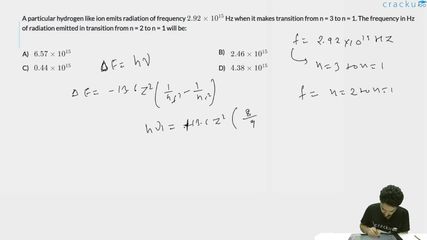
A particular hydrogen like ion emits radiation of frequency $$2.92 \times 10^{15}$$ Hz when it makes transition from n = 3 to n = 1. The frequency in Hz of radiation emitted in transition from n = 2 to n = 1 will be:
We begin with the energy-frequency relation for any photon: $$\Delta E = h\,\nu,$$ where $$\Delta E$$ is the change in energy of the electron and $$\nu$$ is the frequency of the emitted radiation.
For a hydrogen-like ion (single electron, nuclear charge $$Z$$) the energy of the level having principal quantum number $$n$$ is given by the Bohr formula
$$E_n = -\,13.6\ \text{eV}\; \dfrac{Z^{2}}{n^{2}}.$$(The factor $$13.6\ \text{eV}$$ is the ground-state energy of hydrogen.)
When an electron jumps from an initial level $$n_i$$ to a lower level $$n_f$$, the energy released is
$$\Delta E = E_{n_f}-E_{n_i} = -\,13.6\,Z^{2}\!\left(\dfrac{1}{n_f^{2}}-\dfrac{1}{n_i^{2}}\right)\text{eV}.$$
Because the negative sign simply denotes that energy is released, we may write the magnitude of the frequency as
$$\nu = \dfrac{\Delta E}{h} = \dfrac{13.6\,Z^{2}}{h}\!\left(\dfrac{1}{n_f^{2}}-\dfrac{1}{n_i^{2}}\right).$$
Now, for the given ion we know the frequency for the transition $$n=3 \rightarrow n=1$$:
$$\nu_{31} = 2.92 \times 10^{15}\ \text{Hz}.$$
Using the above formula with $$n_i = 3$$ and $$n_f = 1$$ we have
$$\nu_{31}= \dfrac{13.6\,Z^{2}}{h}\!\left(\dfrac{1}{1^{2}}-\dfrac{1}{3^{2}}\right) = \dfrac{13.6\,Z^{2}}{h}\!\left(1-\dfrac{1}{9}\right) = \dfrac{13.6\,Z^{2}}{h}\!\left(\dfrac{8}{9}\right).$$
For the unknown $$Z$$ we retain the factor $$\dfrac{13.6\,Z^{2}}{h}$$ as it will cancel out. Next, the required transition is $$n=2 \rightarrow n=1$$. Its frequency will be
$$\nu_{21}= \dfrac{13.6\,Z^{2}}{h}\!\left(\dfrac{1}{1^{2}}-\dfrac{1}{2^{2}}\right) = \dfrac{13.6\,Z^{2}}{h}\!\left(1-\dfrac{1}{4}\right) = \dfrac{13.6\,Z^{2}}{h}\!\left(\dfrac{3}{4}\right).$$
Because the prefactor $$\dfrac{13.6\,Z^{2}}{h}$$ is common to both expressions, we can write the ratio of the two frequencies directly:
$$\dfrac{\nu_{21}}{\nu_{31}} = \dfrac{\dfrac{3}{4}}{\dfrac{8}{9}} = \dfrac{3}{4}\times\dfrac{9}{8} = \dfrac{27}{32}.$$
Hence,
$$\nu_{21} = \nu_{31}\times\dfrac{27}{32} = \left(2.92 \times 10^{15}\ \text{Hz}\right)\times\dfrac{27}{32}.$$
Now we perform the multiplication step by step. First calculate the numerator:
$$2.92 \times 27 = 78.84.$$
Next divide by 32:
$$\dfrac{78.84}{32} = 2.46375.$$
So,
$$\nu_{21} \approx 2.46 \times 10^{15}\ \text{Hz}.$$
Therefore, the emitted radiation for the $$n=2 \rightarrow n=1$$ transition has a frequency of approximately $$2.46 \times 10^{15}$$ Hz.
Hence, the correct answer is Option B.
Was this solution helpful?
Click on the Email ☝️ to Watch the Video Solution
Create a FREE account and get:
_1.webp)

Educational materials for JEE preparation

Ask our AI anything

AI can make mistakes. Please verify important information.
AI can make mistakes. Please verify important information.
