
Join Our JEE Preparation Group
Prep with like-minded aspirants; Get access to free daily tests and study material.
Sign in
Please select an account to continue using cracku.in
↓ →
Join Our JEE Preparation Group
Prep with like-minded aspirants; Get access to free daily tests and study material.
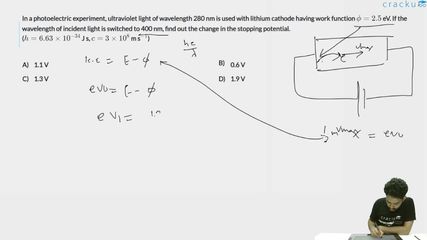
In a photoelectric experiment, ultraviolet light of wavelength 280 nm is used with lithium cathode having work function $$\phi = 2.5$$ eV. If the wavelength of incident light is switched to 400 nm, find out the change in the stopping potential.
($$h = 6.63 \times 10^{-34}$$ J s, $$c = 3 \times 10^8$$ m s$$^{-1}$$)
We can calculate the change in stopping potential by applying Einstein’s photoelectric equation to both wavelengths.
1. Einstein’s Photoelectric Equation
The maximum kinetic energy ($$K_{\text{max}}$$) of an emitted electron is the difference between the incident photon energy ($$h\nu$$) and the work function ($$\phi$$) of the metal:
$$K_{\text{max}} = h\nu - \phi$$
Since the stopping potential ($$V_0$$) is the potential required to stop the most energetic electrons, we have:
$$eV_0 = K_{\text{max}}$$
Combining these, and using $$\nu = \frac{c}{\lambda}$$:
$$eV_0 = \frac{hc}{\lambda} - \phi$$
2. Numerical Constants
To simplify the calculation, we use the value of the product $$hc$$ in electron-volt nanometers ($$\text{eV}\cdot\text{nm}$$):
$$\frac{hc}{e} \approx 1240\ \text{eV}\cdot\text{nm}$$
Thus, the energy of a photon ($$E_p$$) in eV is:
$$E_p = \frac{1240}{\lambda \text{ (nm)}}$$
3. Step-by-Step Calculation
For the first wavelength ($$\lambda_1 = 280$$ nm):
For the second wavelength ($$\lambda_2 = 400$$ nm):
4. Change in Stopping Potential ($$\Delta V$$)
The decrease in stopping potential when switching from $$280$$ nm to $$400$$ nm is:
$$\Delta V = V_{0,1} - V_{0,2}$$
$$\Delta V = 1.93\ \text{V} - 0.60\ \text{V} = 1.33\ \text{V}$$
Conclusion:
Rounding to two significant figures, the change is:
$$\boxed{\Delta V \approx 1.3\ \text{V}}$$
This corresponds to Option C.
Was this solution helpful?
Click on the Email ☝️ to Watch the Video Solution
Create a FREE account and get:
_1.webp)

Educational materials for JEE preparation

Ask our AI anything

AI can make mistakes. Please verify important information.
AI can make mistakes. Please verify important information.
