
Join Our JEE Preparation Group
Prep with like-minded aspirants; Get access to free daily tests and study material.
Sign in
Please select an account to continue using cracku.in
↓ →
Join Our JEE Preparation Group
Prep with like-minded aspirants; Get access to free daily tests and study material.
A simple pendulum of length L is placed between the plates of a parallel plate capacitor having electric field E, as shown in figure. Its bob has mass m and charge q. The time period of the pendulum is given by:
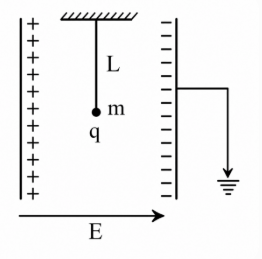
To find the time period of a simple pendulum when subjected to an external electric field, we can use the concept of effective acceleration ($$a_{\text{eff}}$$).
Here is the structured solution breakdown:
1. Understanding the Time Period Formula
The standard time period of a simple pendulum is given by:
$$T = 2\pi \sqrt{\frac{L}{g}}$$
When multiple constant forces act on the bob, acceleration due to gravity $$g$$ is replaced by the effective net acceleration $$a_{\text{eff}}$$ acting on the bob at its equilibrium position:
$$T = 2\pi \sqrt{\frac{L}{a_{\text{eff}}}}$$
2. Analyzing Forces Acting on the Bob
The bob has a mass $$m$$ and a positive charge $$q$$. Two mutually perpendicular constant forces act on it:
$$F_g = mg$$
This produces a downward acceleration $$a_y = g$$.
$$F_e = qE$$
This produces a horizontal acceleration $$a_x = \frac{qE}{m}$$.
3. Calculating Effective Acceleration ($$a_{\text{eff}}$$)
Because the horizontal and vertical accelerations are perpendicular to each other ($$90^\circ$$ angle), we compute their vector sum using the Pythagorean theorem:
$$a_{\text{eff}} = \sqrt{a_y^2 + a_x^2}$$
$$a_{\text{eff}} = \sqrt{g^2 + \left(\frac{qE}{m}\right)^2} = \sqrt{g^2 + \frac{q^2E^2}{m^2}}$$
4. Final Equation for Time Period
Substituting $$a_{\text{eff}}$$ back into the generalized time period formula:
$$T = 2\pi \sqrt{\frac{L}{\sqrt{g^2 + \frac{q^2E^2}{m^2}}}}$$
Was this solution helpful?
Create a FREE account and get:
_1.webp)

Educational materials for JEE preparation

Ask our AI anything

AI can make mistakes. Please verify important information.
AI can make mistakes. Please verify important information.
