
Join Our JEE Preparation Group
Prep with like-minded aspirants; Get access to free daily tests and study material.
Sign in
Please select an account to continue using cracku.in
↓ →
Join Our JEE Preparation Group
Prep with like-minded aspirants; Get access to free daily tests and study material.
A region in the form of an equilateral triangle (in $$x - y$$ plane) of height $$L$$ has a uniform magnetic field $$\vec{B}$$ pointing in the $$+z$$-direction. A conducting loop $$PQR$$, in the form of an equilateral triangle of the same height $$L$$, is placed in the $$x - y$$ plane with its vertex $$P$$ at $$x = 0$$ in the orientation shown in the figure. At $$t = 0$$, the loop starts entering the region of the magnetic field with a uniform velocity $$\vec{v}$$ along the $$+x$$-direction. The plane of the loop and its orientation remain unchanged throughout its motion.
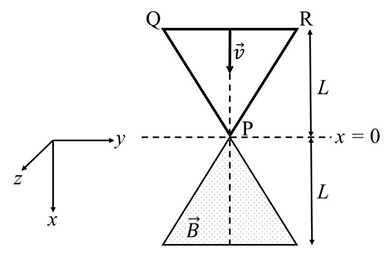
Which of the following graph best depicts the variation of the induced emf ($$E$$) in the loop as a function of the distance ($$x$$) starting from $$x = 0$$?
$$0$$ to $$L$$:
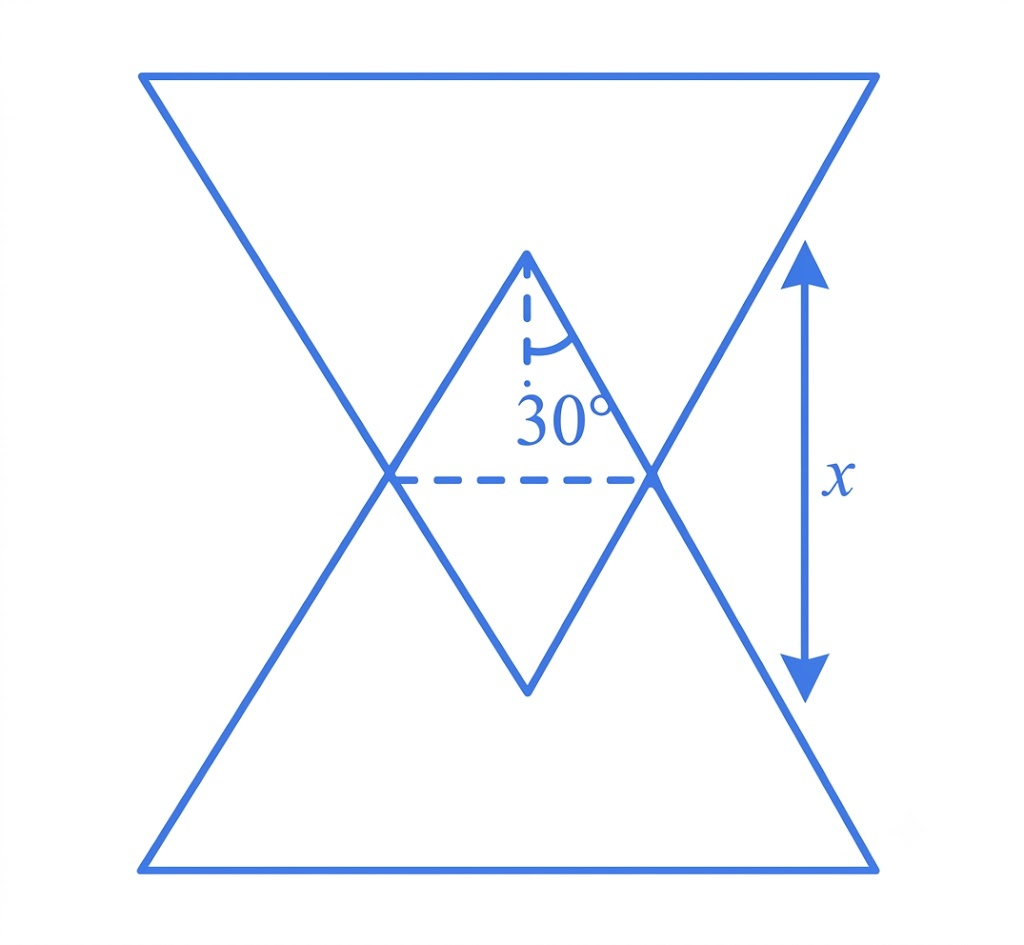
$$\varepsilon = \text{B}\ell_{\text{ent}}\text{v} = \text{B} \times \frac{x}{\sqrt{3}}\text{v}$$
$$\text{L to } 2\text{ L}$$:
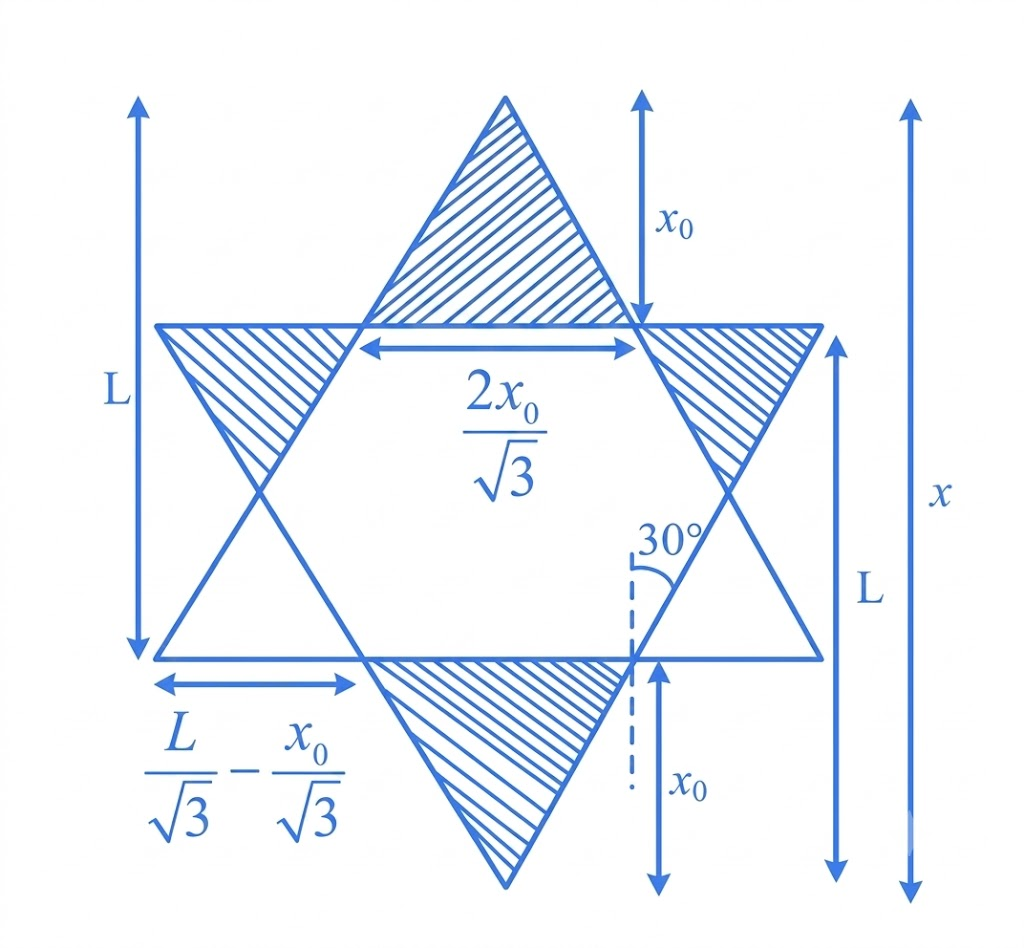
$$\vert{}\text{emf}\vert{} = B \left( \frac{L}{\sqrt{3}} - \frac{x_0}{\sqrt{3}} \right)v - B \frac{2x_0}{\sqrt{3}}v$$
$$= \frac{BvL}{\sqrt{3}} - \sqrt{3}Bvx_0$$
$$= Bv \left[ \frac{L}{\sqrt{3}} - \sqrt{3}(x - L) \right]$$
$$= \frac{Bv}{\sqrt{3}} [L - 3x + 3L]$$
$$= \frac{Bv}{\sqrt{3}} [4L - 3x]$$
$$\text{at } x = \frac{4L}{3}$$: $$\text{emf } = 0$$
Create a FREE account and get:
_1.webp)

Educational materials for JEE preparation

Ask our AI anything

AI can make mistakes. Please verify important information.
AI can make mistakes. Please verify important information.


