
Join Our JEE Preparation Group
Prep with like-minded aspirants; Get access to free daily tests and study material.
Sign in
Please select an account to continue using cracku.in
↓ →
Join Our JEE Preparation Group
Prep with like-minded aspirants; Get access to free daily tests and study material.
A ray of light entering from air into a denser medium of refractive index $$\frac{4}{3}$$, as shown in figure. The light ray suffers total internal reflection at the adjacent surface as shown. The maximum value of angle $$\theta$$ should be equal to:
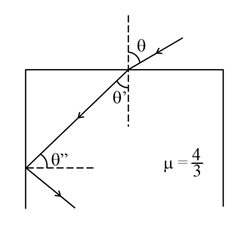
We need to determine the maximum value of the angle of incidence $$\theta$$ such that the light ray undergoes total internal reflection (TIR) at the adjacent vertical interface.
From the problem statement:
For total internal reflection to occur at the vertical wall boundary with air, the angle of incidence must be greater than or equal to the critical angle ($$\theta_c$$):
$$90^\circ - r \ge \theta_c \implies \sin(90^\circ - r) \ge \sin\theta_c$$
$$\cos r \ge \frac{1}{n}$$
To express this in terms of sine, we use the trigonometric identity $$\cos r = \sqrt{1 - \sin^2 r}$$:
$$\sqrt{1 - \sin^2 r} \ge \frac{1}{n} \implies 1 - \sin^2 r \ge \frac{1}{n^2} \implies \sin^2 r \le 1 - \frac{1}{n^2}$$
Applying Snell's Law at the first horizontal boundary where light enters from air into the medium:
$$1 \cdot \sin\theta = n \cdot \sin r \implies \sin r = \frac{\sin\theta}{n}$$
Substitute this expression into our inequality condition from Step 2:
$$\left(\frac{\sin\theta}{n}\right)^2 \le 1 - \frac{1}{n^2} \implies \frac{\sin^2\theta}{n^2} \le \frac{n^2 - 1}{n^2}$$
Cancel out the common $$n^2$$ terms in the denominators:
$$\sin^2\theta \le n^2 - 1 \implies \sin\theta \le \sqrt{n^2 - 1}$$
Substitute the given refractive index $$n = \frac{4}{3}$$ into the formula to find the maximum angle constraint:
$$\sin\theta_{\text{max}} = \sqrt{\left(\frac{4}{3}\right)^2 - 1} = \sqrt{\frac{16}{9} - 1} = \sqrt{\frac{7}{9}} = \frac{\sqrt{7}}{3}$$
Isolating $$\theta$$ gives the maximum allowable limit:
$$\theta = \sin^{-1}\left(\frac{\sqrt{7}}{3}\right)$$
The maximum value of the angle $$\theta$$ must be equal to $$\sin^{-1}\left(\frac{\sqrt{7}}{3}\right)$$, which corresponds exactly to Option A.
Was this solution helpful?
Create a FREE account and get:
_1.webp)

Educational materials for JEE preparation

Ask our AI anything

AI can make mistakes. Please verify important information.
AI can make mistakes. Please verify important information.
