
Join Our JEE Preparation Group
Prep with like-minded aspirants; Get access to free daily tests and study material.
Sign in
Please select an account to continue using cracku.in
↓ →
Join Our JEE Preparation Group
Prep with like-minded aspirants; Get access to free daily tests and study material.
A prism of refractive index $$\mu$$ and angle of prism $$A$$ is placed in the position of minimum angle of deviation. If minimum angle of deviation is also $$A$$, then in terms of refractive index,
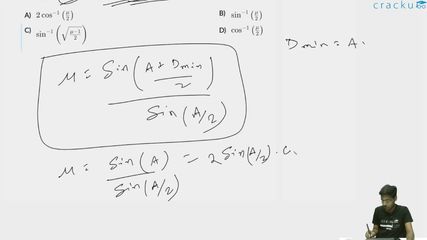
We begin with the well-known prism formula that relates the refractive index $$\mu$$, the angle of the prism $$A$$ and the minimum angle of deviation $$D_{\min}$$. The formula is
$$\mu \;=\; \frac{\sin\!\left(\dfrac{A + D_{\min}}{2}\right)}{\sin\!\left(\dfrac{A}{2}\right)}.$$
In the statement of the question it is given that the prism is adjusted so that the minimum deviation itself equals the prism angle, that is
$$D_{\min} \;=\; A.$$
Substituting this equality into the formula, we obtain
$$\mu \;=\; \frac{\sin\!\left(\dfrac{A + A}{2}\right)}{\sin\!\left(\dfrac{A}{2}\right)} \;=\; \frac{\sin\!\left(\dfrac{2A}{2}\right)}{\sin\!\left(\dfrac{A}{2}\right)} \;=\; \frac{\sin(A)}{\sin\!\left(\dfrac{A}{2}\right)}.$$
Now we expand $$\sin(A)$$ using the double-angle identity $$\sin(2\theta)=2\sin\theta\cos\theta$$. Taking $$\theta=\dfrac{A}{2}$$ we have
$$\sin(A) \;=\; 2\sin\!\left(\dfrac{A}{2}\right)\cos\!\left(\dfrac{A}{2}\right).$$
Substituting this value of $$\sin(A)$$ back into the expression for $$\mu$$ gives
$$\mu \;=\; \frac{2\sin\!\left(\dfrac{A}{2}\right)\cos\!\left(\dfrac{A}{2}\right)}{\sin\!\left(\dfrac{A}{2}\right)} \;=\; 2\cos\!\left(\dfrac{A}{2}\right).$$
The factor $$\sin\!\left(\dfrac{A}{2}\right)$$ in numerator and denominator cancels completely, leaving the clean relation
$$\cos\!\left(\dfrac{A}{2}\right) \;=\; \frac{\mu}{2}.$$
To express $$A$$ explicitly, we take the inverse cosine of both sides:
$$\dfrac{A}{2} \;=\; \cos^{-1}\!\left(\frac{\mu}{2}\right).$$
Finally, multiplying both sides by 2 yields the required formula for the prism angle in terms of its refractive index:
$$A \;=\; 2\,\cos^{-1}\!\left(\frac{\mu}{2}\right).$$
Among the provided options this expression matches exactly with Option A.
Hence, the correct answer is Option A.
Was this solution helpful?
Click on the Email ☝️ to Watch the Video Solution
Create a FREE account and get:
_1.webp)

Educational materials for JEE preparation

Ask our AI anything

AI can make mistakes. Please verify important information.
AI can make mistakes. Please verify important information.
