
Join Our JEE Preparation Group
Prep with like-minded aspirants; Get access to free daily tests and study material.
Sign in
Please select an account to continue using cracku.in
↓ →
Join Our JEE Preparation Group
Prep with like-minded aspirants; Get access to free daily tests and study material.
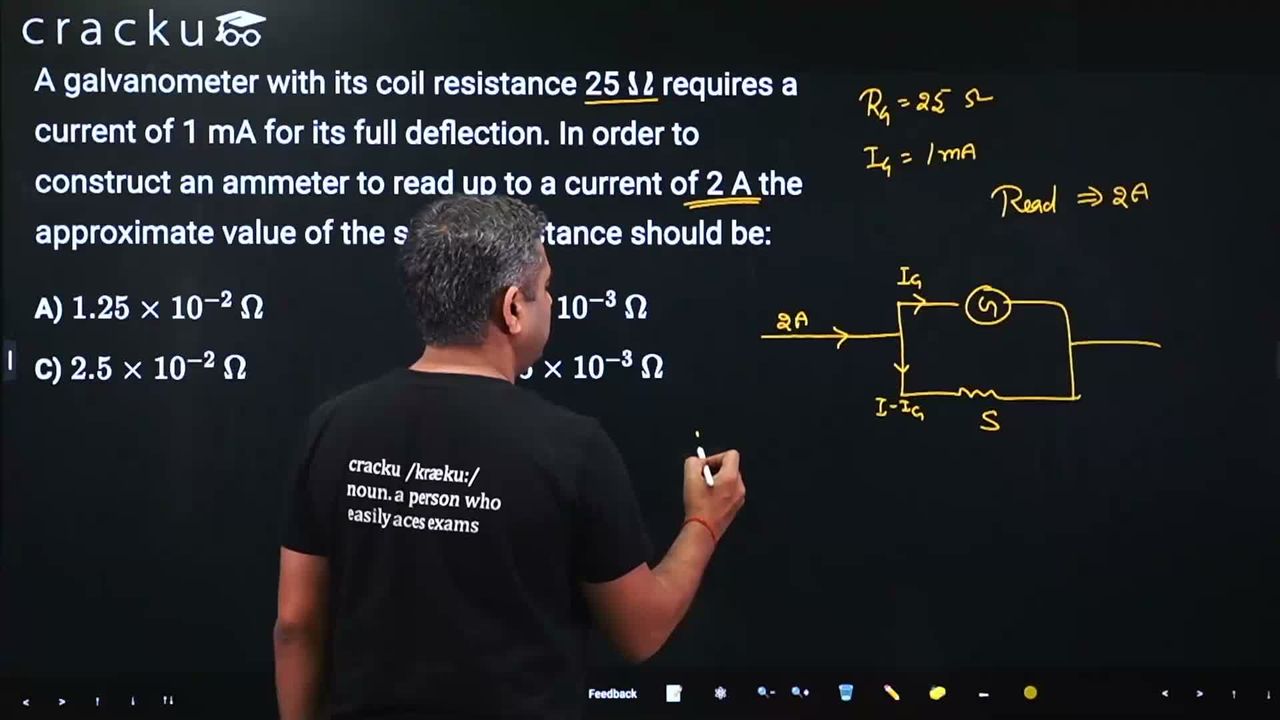
A galvanometer with its coil resistance 25 $$\Omega$$ requires a current of 1 mA for its full deflection. In order to construct an ammeter to read up to a current of 2 A the approximate value of the shunt resistance should be:
We start with the data given in the question. The resistance of the galvanometer coil is $$R_g = 25 \, \Omega$$. The current needed for full-scale deflection of this galvanometer is $$I_g = 1 \, \text{mA} = 0.001 \, \text{A}$$. We wish to convert this galvanometer into an ammeter that can measure currents up to $$I = 2 \, \text{A}$$.
To achieve this, a low resistance called a shunt $$R_s$$ is connected in parallel with the galvanometer. Because the galvanometer and the shunt are in parallel, the potential difference (voltage) across each of them must be identical. This basic requirement leads to the key relation that we will use.
Formula to be used: For a galvanometer of resistance $$R_g$$ carrying its full-scale current $$I_g$$ in parallel with a shunt of resistance $$R_s$$ that carries a current $$I_s$$, the equality of voltages gives $$ I_g R_g \;=\; I_s R_s. $$
Before using this equation, we need the value of $$I_s$$, the current that will bypass the galvanometer through the shunt when the total current is $$I = 2 \, \text{A}$$. Since the galvanometer can take only $$I_g = 0.001 \, \text{A}$$ safely, the remainder of the total current must pass through the shunt:
$$ I_s \;=\; I - I_g \;=\; 2 \,\text{A} - 0.001 \,\text{A} \;=\; 1.999 \,\text{A}. $$
Now we substitute the known values into the voltage-equality formula:
$$ I_g R_g \;=\; I_s R_s. $$
Putting in $$I_g = 0.001 \,\text{A}$$ and $$R_g = 25 \,\Omega$$ on the left-hand side, and $$I_s = 1.999 \,\text{A}$$ on the right-hand side, we have
$$ (0.001 \, \text{A})(25 \, \Omega) \;=\; (1.999 \, \text{A})\, R_s. $$
We first evaluate the product on the left:
$$ 0.001 \times 25 \;=\; 0.025 \, \text{V}. $$
This gives
$$ 0.025 \, \text{V} \;=\; 1.999 \, \text{A} \times R_s. $$
Solving for $$R_s$$, we divide both sides by $$1.999 \, \text{A}$$:
$$ R_s \;=\; \frac{0.025 \, \text{V}}{1.999 \, \text{A}}. $$
Performing the division, we obtain
$$ R_s \;\approx\; 0.0125 \, \Omega. $$
It is often convenient to express this resistance in scientific notation:
$$ 0.0125 \, \Omega \;=\; 1.25 \times 10^{-2} \, \Omega. $$
Looking at the given options, the value $$1.25 \times 10^{-2} \, \Omega$$ corresponds to Option A.
Hence, the correct answer is Option A.
Was this solution helpful?
Click on the Email ☝️ to Watch the Video Solution
Create a FREE account and get:
_1.webp)

Educational materials for JEE preparation

Ask our AI anything

AI can make mistakes. Please verify important information.
AI can make mistakes. Please verify important information.
