
Join Our JEE Preparation Group
Prep with like-minded aspirants; Get access to free daily tests and study material.
Sign in
Please select an account to continue using cracku.in
↓ →
Join Our JEE Preparation Group
Prep with like-minded aspirants; Get access to free daily tests and study material.
To verify Ohm's law, a student connects the voltmeter across the battery as shown in the figure. The measured voltage is plotted as a function of the current, and the following graph is obtained.
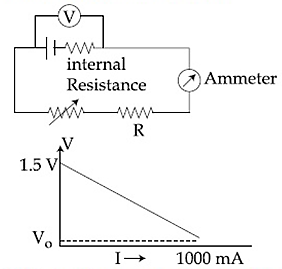
If V$$_0$$ is almost zero, identify the correct statement:
To find the electromotive force ($$\text{emf}$$, $$E$$) and the internal resistance ($$r$$) of the battery, we use the relationship between terminal potential difference ($$V$$), current ($$I$$), and internal resistance during discharging.
Here is the structured, step-by-step calculation based on the provided circuit and graph.
1. Governing Equation
The terminal voltage $$V$$ measured by the voltmeter across a battery supplying a current $$I$$ is given by the equation:
$$V = E - Ir$$
Rearranging this into the standard slope-intercept form of a straight line ($$y = mx + c$$):
$$V = (-r)I + E$$
2. Finding the Electromotive Force ($$E$$)
From the given graph, when the current in the circuit is zero ($$I = 0$$):
$$V = 1.5\text{ V}$$
Substituting $$I = 0$$ into our governing equation:
$$1.5 = E - (0)r \implies E = 1.5\text{ V}$$
Thus, the emf of the battery is $$1.5\text{ V}$$.
3. Finding the Internal Resistance ($$r$$)
The graph shows that when the terminal potential difference falls to $$V_0 \approx 0\text{ V}$$, the current reaches its maximum value:
$$I = 1000\text{ mA} = 1\text{ A}$$
Substituting $$V = 0$$, $$E = 1.5\text{ V}$$, and $$I = 1\text{ A}$$ into the equation:
$$0 = 1.5 - (1\text{ A}) \cdot r$$
$$1 \cdot r = 1.5$$
$$r = 1.5\ \Omega$$
Thus, the internal resistance of the battery is $$1.5\ \Omega$$.
Final Conclusion
Was this solution helpful?
Create a FREE account and get:
_1.webp)

Educational materials for JEE preparation

Ask our AI anything

AI can make mistakes. Please verify important information.
AI can make mistakes. Please verify important information.
