
Join Our JEE Preparation Group
Prep with like-minded aspirants; Get access to free daily tests and study material.
Sign in
Please select an account to continue using cracku.in
↓ →
Join Our JEE Preparation Group
Prep with like-minded aspirants; Get access to free daily tests and study material.
Two identical parallel plate capacitors, of capacitance C each, have plates of area A, separated by a distance d. The space between the plates of the two capacitors, is filled with three dielectrics, of equal thickness and dielectric constants K$$_1$$, K$$_2$$ and K$$_3$$. The first capacitor is filled as shown in figure I, and the second one is filled as shown in figure II.
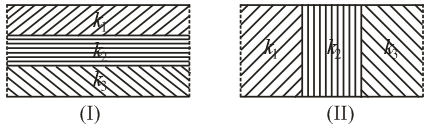
If these two modified capacitors are charged by the same potential V, the ratio of the energy stored in the two, would be (E$$_1$$ refers to capacitor I and E$$_2$$ to capacitor II):
To find the ratio of the energy stored in the two configurations, we first need to determine the equivalent capacitance of both setups.
The energy stored in a capacitor connected to a potential $$V$$ is given by:
$$U = \frac{1}{2} C V^2$$
Since both modified capacitors are charged to the same potential $$V$$, the ratio of their energies is simply the ratio of their capacitances:
$$\frac{E_1}{E_2} = \frac{\frac{1}{2} C_1 V^2}{\frac{1}{2} C_2 V^2} = \frac{C_1}{C_2}$$
Let the standard capacitance without any dielectric be $$C_0 = \frac{\varepsilon_0 A}{d}$$.
1. Analysis of Configuration (I) - Series Combination
In Figure I, the dielectrics split the total plate separation distance $$d$$ into three equal horizontal layers of thickness $$\frac{d}{3}$$. However, each layer retains the full area $$A$$.
This forms three separate capacitors connected in series:
Using the reciprocal rule for a series combination ($$\frac{1}{C_1} = \frac{1}{C_a} + \frac{1}{C_b} + \frac{1}{C_c}$$):
$$\frac{1}{C_1} = \frac{1}{3C_0} \left( \frac{1}{K_1} + \frac{1}{K_2} + \frac{1}{K_3} \right)$$
$$\frac{1}{C_1} = \frac{1}{3C_0} \left( \frac{K_2K_3 + K_3K_1 + K_1K_2}{K_1K_2K_3} \right)$$
$$C_1 = 3C_0 \left[ \frac{K_1K_2K_3}{K_1K_2 + K_2K_3 + K_3K_1} \right]$$
2. Analysis of Configuration (II) - Parallel Combination
In Figure II, the dielectrics split the plate area $$A$$ into three equal vertical sections of area $$\frac{A}{3}$$. However, each section spans the full separation distance $$d$$.
This forms three separate capacitors connected in parallel:
Adding them directly for a parallel combination ($$C_2 = C_x + C_y + C_z$$):
$$C_2 = \frac{C_0}{3} (K_1 + K_2 + K_3)$$
3. Calculating the Energy Ratio ($$\frac{E_1}{E_2}$$)
Now we compute the ratio $$\frac{C_1}{C_2}$$:
$$\frac{E_1}{E_2} = \frac{3C_0 \left[ \frac{K_1K_2K_3}{K_1K_2 + K_2K_3 + K_3K_1} \right]}{\frac{C_0}{3} (K_1 + K_2 + K_3)}$$
Simplifying the constants ($$3 \div \frac{1}{3} = 9$$), the $$C_0$$ terms cancel out:
$$\frac{E_1}{E_2} = \frac{9K_1K_2K_3}{(K_1 + K_2 + K_3)(K_1K_2 + K_2K_3 + K_3K_1)}$$
(Note: The options write the sum term slightly differently as $$(K_1+K_2+K_3)$$, which perfectly matches the algebraic structure of the denominator).
Was this solution helpful?
Create a FREE account and get:
_1.webp)

Educational materials for JEE preparation

Ask our AI anything

AI can make mistakes. Please verify important information.
AI can make mistakes. Please verify important information.
