
Join Our JEE Preparation Group
Prep with like-minded aspirants; Get access to free daily tests and study material.
Sign in
Please select an account to continue using cracku.in
↓ →
Join Our JEE Preparation Group
Prep with like-minded aspirants; Get access to free daily tests and study material.
Three rays of light, namely red (R), green (G) and blue (B) are incident on the face PQ of a right angled prism PQR as shown in figure.
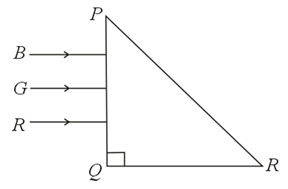
The refractive indices of the material of the prism for red, green and blue wavelength are 1.27, 1.42 and 1.49 respectively. The colour of the ray(s) emerging out of the face PR is :
We need to determine which of the three incident light rays (red, green, or blue) will emerge from the face $$PR$$ of the right-angled isosceles prism.
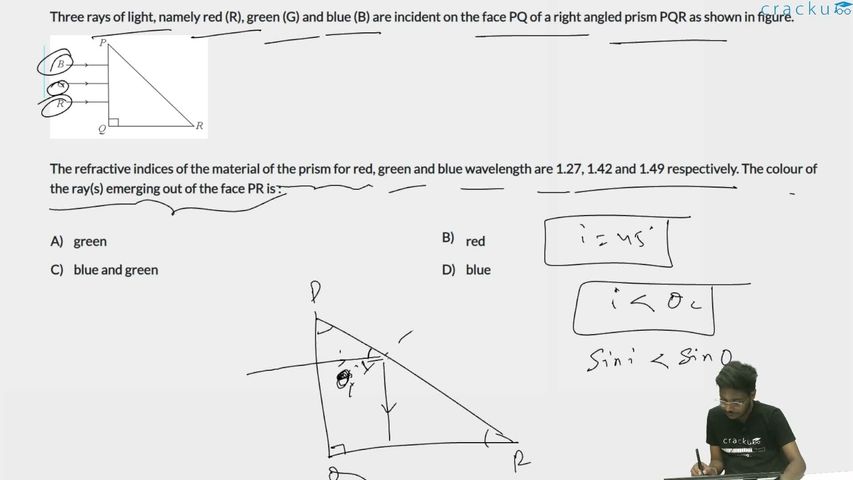
From the diagram , the right-angled prism $$PQR$$ appears to be an isosceles prism where $$\angle Q = 90^\circ$$ and the remaining angles are $$\angle P = \angle R = 45^\circ$$.
The normal to the face $$PR$$ makes an angle of $$45^\circ$$ with the horizontal pathway of the light. Hence, the angle of incidence inside the glass medium is:
$$i = 45^\circ$$
For a light ray to escape or emerge out of the face $$PR$$ into the air, it must not undergo Total Internal Reflection. This means its angle of incidence must be less than the critical angle ($$i < \theta_c$$).
Mathematically, the condition for emergence is:
$$\sin i > \sin \theta_c \implies \sin 45^\circ > \frac{1}{\mu}$$
$$\frac{1}{\sqrt{2}} > \frac{1}{\mu} \implies \mu < \sqrt{2}$$
Since $$\sqrt{2} \approx 1.414$$, any light ray belonging to a wavelength whose refractive index ($$\mu$$) is less than 1.414 will refract out into the air. Conversely, if $$\mu > 1.414$$, the ray will undergo TIR and fail to emerge from face $$PR$$.
Let's check the given refractive indices against our threshold requirement ($$\mu < 1.414$$):
| Ray Colour | Refractive Index ($$\mu$$) | Comparison ($$\mu \text{ vs } 1.414$$) | Behavior at Face PR |
|---|---|---|---|
| Red (R) | 1.27 | $$1.27 < 1.414$$ | Emerges out (Refraction) |
| Green (G) | 1.42 | $$1.42 > 1.414$$ | Undergoes TIR (Trapped) |
| Blue (B) | 1.49 | $$1.49 > 1.414$$ | Undergoes TIR (Trapped) |
Only the red light ray satisfies the condition to escape the prism surface. Therefore, the color of the ray emerging out of the face $$PR$$ is red, which corresponds to Option B.
Was this solution helpful?
Click on the Email ☝️ to Watch the Video Solution
Create a FREE account and get:
_1.webp)

Educational materials for JEE preparation

Ask our AI anything

AI can make mistakes. Please verify important information.
AI can make mistakes. Please verify important information.
