
Join Our JEE Preparation Group
Prep with like-minded aspirants; Get access to free daily tests and study material.
Sign in
Please select an account to continue using cracku.in
↓ →
Join Our JEE Preparation Group
Prep with like-minded aspirants; Get access to free daily tests and study material.
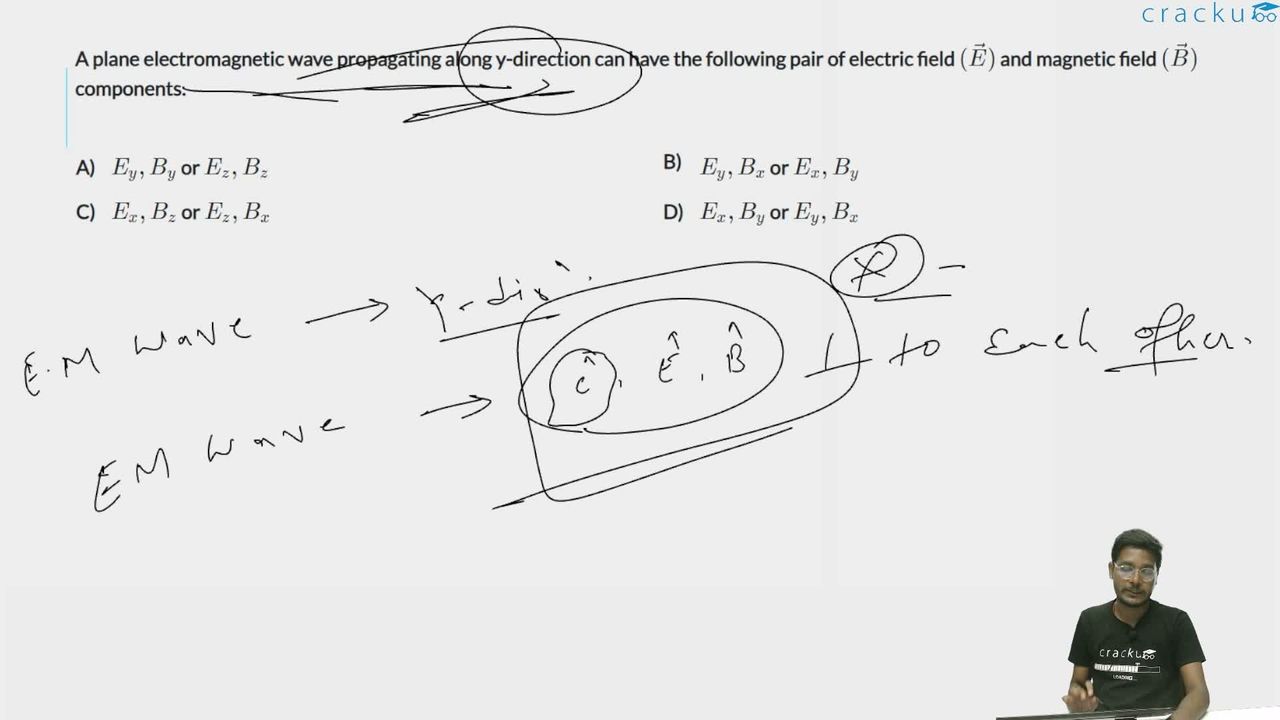
A plane electromagnetic wave propagating along y-direction can have the following pair of electric field $$(\vec{E})$$ and magnetic field $$(\vec{B})$$ components.
An electromagnetic wave propagating along the y-direction requires both $$\vec{E}$$ and $$\vec{B}$$ to lie in the xz-plane (perpendicular to $$\hat{y}$$). Additionally, $$\vec{E}$$ and $$\vec{B}$$ must be mutually perpendicular, and the Poynting vector $$\vec{E} \times \vec{B}$$ must point along $$\hat{y}$$.
Let us check each option. Option (1): $$E_y, B_y$$ — both are along the propagation direction, which violates the transverse nature of EM waves. Invalid. Option (2): $$E_y, B_z$$ or $$E_z, B_y$$ — each pair contains a y-component, which is not allowed for a wave propagating in the y-direction. Invalid.
Option (4): $$E_z, B_y$$ or $$E_y, B_z$$ — again, each pair contains a y-component. Invalid.
Option (3): $$E_z, B_z$$ or $$E_z, B_x$$. Consider the second pair: $$E_z$$ and $$B_x$$ are both perpendicular to $$\hat{y}$$, they are perpendicular to each other, and $$\hat{z} \times \hat{x} = \hat{y}$$, giving the correct propagation direction. This is a valid EM wave configuration. As for the first pair $$E_z, B_z$$, both fields would be parallel, which is not a valid EM wave on its own — however, the question uses "or" between the pairs, so only one valid pair is needed for the option to be correct.
Since option (3) contains the valid pair $$(E_z, B_x)$$ and is the only option with at least one fully valid perpendicular pair of transverse components, it is the correct answer.
Was this solution helpful?
Click on the Email ☝️ to Watch the Video Solution
Create a FREE account and get:
_1.webp)

Educational materials for JEE preparation

Ask our AI anything

AI can make mistakes. Please verify important information.
AI can make mistakes. Please verify important information.
