
Join Our JEE Preparation Group
Prep with like-minded aspirants; Get access to free daily tests and study material.
Sign in
Please select an account to continue using cracku.in
↓ →
Join Our JEE Preparation Group
Prep with like-minded aspirants; Get access to free daily tests and study material.
The time taken for the magnetic energy to reach 25% of its maximum value, when a solenoid of resistance $$R$$, inductance $$L$$ is connected to a battery, is :
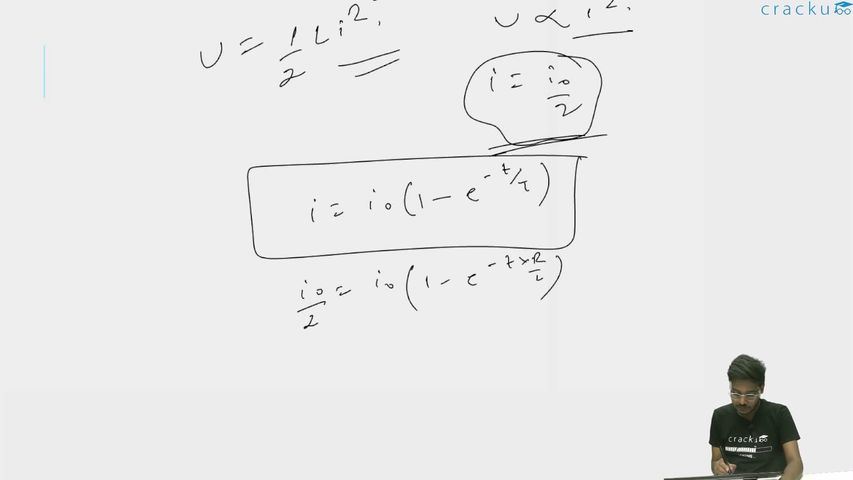
When a solenoid of inductance $$L$$ and resistance $$R$$ is connected to a battery, the current grows as $$i = i_0\left(1 - e^{-Rt/L}\right)$$, where $$i_0$$ is the maximum (steady-state) current.
The magnetic energy stored in the inductor is $$U = \frac{1}{2}Li^2 = \frac{1}{2}Li_0^2\left(1 - e^{-Rt/L}\right)^2$$. The maximum energy is $$U_{\max} = \frac{1}{2}Li_0^2$$.
Setting $$U = \frac{1}{4}U_{\max}$$ gives $$\left(1 - e^{-Rt/L}\right)^2 = \frac{1}{4}$$. Taking the positive square root: $$1 - e^{-Rt/L} = \frac{1}{2}$$, so $$e^{-Rt/L} = \frac{1}{2}$$.
Taking the natural logarithm: $$-\frac{Rt}{L} = -\ln 2$$, giving $$t = \frac{L}{R}\ln 2$$.
Was this solution helpful?
Click on the Email ☝️ to Watch the Video Solution
Create a FREE account and get:
_1.webp)

Educational materials for JEE preparation

Ask our AI anything

AI can make mistakes. Please verify important information.
AI can make mistakes. Please verify important information.
