
Join Our JEE Preparation Group
Prep with like-minded aspirants; Get access to free daily tests and study material.
Sign in
Please select an account to continue using cracku.in
↓ →
Join Our JEE Preparation Group
Prep with like-minded aspirants; Get access to free daily tests and study material.
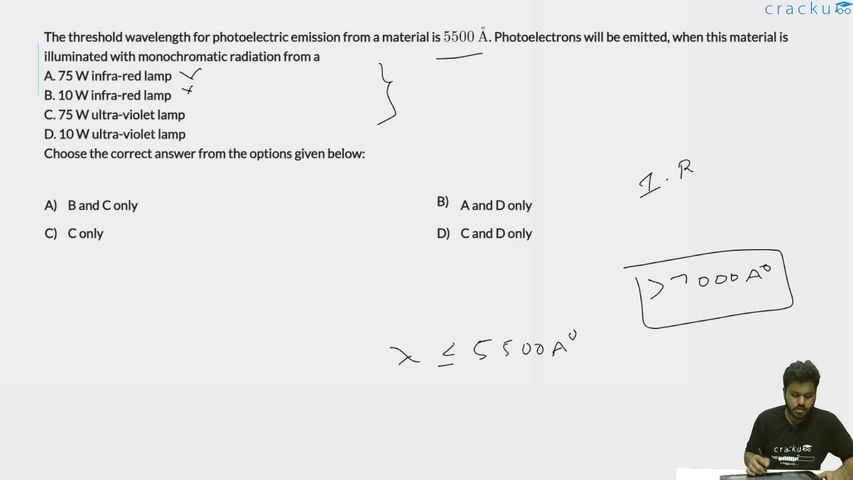
The threshold wavelength for photoelectric emission from a material is $$5500$$ $$\text{\AA}$$. Photoelectrons will be emitted, when this material is illuminated with monochromatic radiation from a
A. 75 W infra-red lamp
B. 10 W infra-red lamp
C. 75 W ultra-violet lamp
D. 10 W ultra-violet lamp
Choose the correct answer from the options given below:
Threshold wavelength = 5500 Å. We need to identify which sources cause photoelectric emission.
Key Concept: Photoelectric emission occurs only when the incident light has wavelength less than or equal to the threshold wavelength. The power (wattage) doesn't matter — only the wavelength determines whether emission occurs.
Analysis:
- Infrared radiation has wavelength > 5500 Å (typically > 7000 Å). Since this exceeds the threshold, no emission occurs regardless of power.
- Ultraviolet radiation has wavelength < 4000 Å, which is less than 5500 Å. So emission occurs regardless of power.
Therefore:
A. 75 W infrared lamp — NO emission
B. 10 W infrared lamp — NO emission
C. 75 W ultraviolet lamp — YES emission
D. 10 W ultraviolet lamp — YES emission
The correct answer is Option 4: C and D only.
The answer is $$\boxed{\text{C and D only}}$$.
Was this solution helpful?
Click on the Email ☝️ to Watch the Video Solution
Create a FREE account and get:
_1.webp)

Educational materials for JEE preparation

Ask our AI anything

AI can make mistakes. Please verify important information.
AI can make mistakes. Please verify important information.
