
Join Our JEE Preparation Group
Prep with like-minded aspirants; Get access to free daily tests and study material.
Sign in
Please select an account to continue using cracku.in
↓ →
Join Our JEE Preparation Group
Prep with like-minded aspirants; Get access to free daily tests and study material.
If $$\sum_{r=1}^n T_r=\frac{(2n-1)(2n+1)(2n+3)(2n+5)}{64}$$ then $$\lim_{n \rightarrow \infty} \sum_{r=1}^n\left( \frac {1}{T_r}\right)$$ is equal to:
Let the sum of the first $$n$$ terms be denoted by $$S_n$$.
$$S_n = \sum_{r=1}^{n} T_r = \frac{(2n-1)(2n+1)(2n+3)(2n+5)}{64}$$
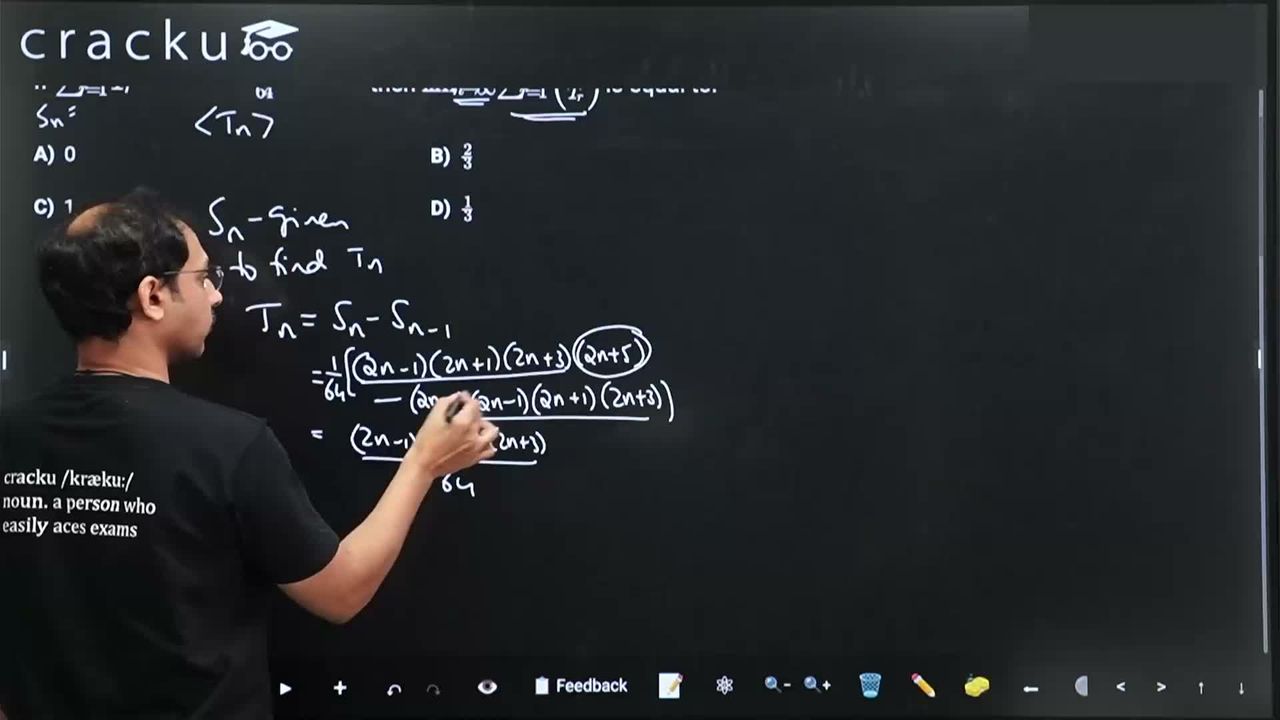
To find the $$n$$th term $$T_n$$, we use the relation, $$T_n = S_n - S_{n-1}$$.
$$S_{n-1} = \frac{(2(n-1)-1)(2(n-1)+1)(2(n-1)+3)(2(n-1)+5)}{64},$$ $$S_{n-1} = \frac{(2n-3)(2n-1)(2n+1)(2n+3)}{64}$$
Subtracting $$S_{n-1}$$ from $$S_n$$:
$$T_n = \frac{(2n-1)(2n+1)(2n+3)(2n+5)}{64} - \frac{(2n-3)(2n-1)(2n+1)(2n+3)}{64}$$
Factor out the common terms:
$$T_n = \frac{(2n-1)(2n+1)(2n+3)}{64} [ (2n+5) - (2n-3) ],$$ $$T_n = \frac{(2n-1)(2n+1)(2n+3)}{64} [ 8 ],$$ $$T_n = \frac{(2n-1)(2n+1)(2n+3)}{8}$$
Therefore, the general term is $$T_r = \frac{(2r-1)(2r+1)(2r+3)}{8}$$.
We need to evaluate the limit of the sum of the reciprocals. First, find the reciprocal of the general term:
$$\frac{1}{T_r} = \frac{8}{(2r-1)(2r+1)(2r+3)}$$
We can solve this using the method of differences by splitting the fraction. Let us define a sequence $$V_r = \frac{1}{(2r-1)(2r+1)}$$.
Then, the difference between consecutive terms is:
$$V_r - V_{r+1} = \frac{1}{(2r-1)(2r+1)} - \frac{1}{(2r+1)(2r+3)},$$ $$V_r - V_{r+1} = \frac{(2r+3) - (2r-1)}{(2r-1)(2r+1)(2r+3)},$$ $$V_r - V_{r+1} = \frac{4}{(2r-1)(2r+1)(2r+3)}$$
By multiplying both sides by 2, we can match our expression for $$\frac{1}{T_r}$$:
$$2(V_r - V_{r+1}) = \frac{8}{(2r-1)(2r+1)(2r+3)} = \frac{1}{T_r}$$
Now, sum the terms from $$r=1$$ to $$n$$:
$$\sum_{r=1}^{n} \frac{1}{T_r} = \sum_{r=1}^{n} 2(V_r - V_{r+1})$$ $$\sum_{r=1}^{n} \frac{1}{T_r} = 2 [ (V_1 - V_2) + (V_2 - V_3) + \dots + (V_n - V_{n+1}) ]$$
This forms a telescoping series where all intermediate terms cancel out, leaving only the first and last terms:
$$\sum_{r=1}^{n} \frac{1}{T_r} = 2 [ V_1 - V_{n+1} ]$$
Calculate the values of $$V_1$$ and $$V_{n+1}$$:
$$V_1 = \frac{1}{(2(1)-1)(2(1)+1)} = \frac{1}{(1)(3)} = \frac{1}{3}$$ $$V_{n+1} = \frac{1}{(2n+1)(2n+3)}$$
Substitute these back into the sum:
$$\sum_{r=1}^{n} \frac{1}{T_r} = 2 \left( \frac{1}{3} - \frac{1}{(2n+1)(2n+3)} \right)$$
Finally, evaluate the limit as $$n$$ approaches infinity. As $$n \to \infty$$, the fraction $$\frac{1}{(2n+1)(2n+3)}$$ approaches zero.
$$\lim_{n \to \infty} \sum_{r=1}^{n} \frac{1}{T_r} = 2 \left( \frac{1}{3} - 0 \right)$$ $$\lim_{n \to \infty} \sum_{r=1}^{n} \frac{1}{T_r} = \frac{2}{3}$$
The final answer is $$\frac{2}{3}$$.
Was this solution helpful?
Click on the Email ☝️ to Watch the Video Solution
Create a FREE account and get:
_1.webp)

Educational materials for JEE preparation

Ask our AI anything

AI can make mistakes. Please verify important information.
AI can make mistakes. Please verify important information.
