
Join Our JEE Preparation Group
Prep with like-minded aspirants; Get access to free daily tests and study material.
Sign in
Please select an account to continue using cracku.in
↓ →
Join Our JEE Preparation Group
Prep with like-minded aspirants; Get access to free daily tests and study material.
The arm PQ of a rectangular conductor is moving from $$x = 0$$ to $$x = 2b$$ outwards and then inwards from $$x = 2b$$ to $$x = 0$$ as shown in the figure. A uniform magnetic field perpendicular to the plane is acting from $$x = 0$$ to $$x = b$$. Identify the graph showing the variation of different quantities with distance:
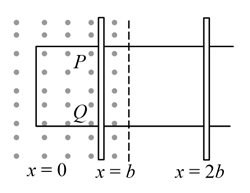
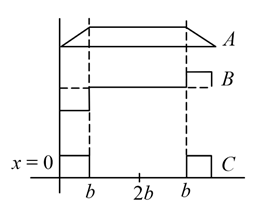
For outwards journey ($$x = 0$$ to $$x = 2b$$):
$$\Phi = Blx \quad (0 \le x < b)$$
$$\Phi = Blb \quad (b \le x \le 2b)$$
$$\varepsilon = -Blv \quad (0 \le x < b) \quad \text{and} \quad \varepsilon = 0 \quad (b \le x \le 2b)$$
$$P = \frac{(Blv)^2}{R} \quad (0 \le x < b) \quad \text{and} \quad P = 0 \quad (b \le x \le 2b)$$
For inwards journey ($$x = 2b$$ back to $$x = 0$$):
$$\Phi = Blb \quad (2b \ge x > b)$$
$$\Phi = Blx \quad (b \ge x \ge 0)$$
$$\varepsilon = +Blv \quad (b \ge x \ge 0) \quad \text{and} \quad \varepsilon = 0 \quad (2b \ge x > b)$$
$$P = \frac{(Blv)^2}{R} \quad (b \ge x \ge 0) \quad \text{and} \quad P = 0 \quad (2b \ge x > b)$$
$$\text{Curve A stays continuous and linear/flat throughout} \implies \text{Flux}$$
$$\text{Curve B switches polarity between outward/inward runs} \implies \text{EMF}$$
$$\text{Curve C stays purely positive and unipolar} \implies \text{Power dissipated}$$
Was this solution helpful?
Create a FREE account and get:
_1.webp)

Educational materials for JEE preparation

Ask our AI anything

AI can make mistakes. Please verify important information.
AI can make mistakes. Please verify important information.


