
Join Our JEE Preparation Group
Prep with like-minded aspirants; Get access to free daily tests and study material.
Sign in
Please select an account to continue using cracku.in
↓ →
Join Our JEE Preparation Group
Prep with like-minded aspirants; Get access to free daily tests and study material.
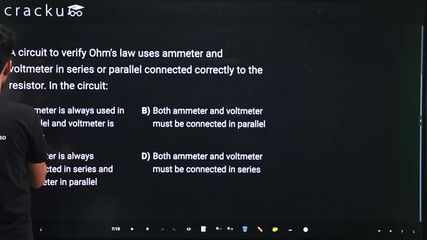
A circuit to verify Ohm's law uses ammeter and voltmeter in series or parallel connected correctly to the resistor. In the circuit:
We begin by recalling the basic purpose of the two measuring instruments used while verifying Ohm’s law with a resistor.
An ammeter is meant to measure the current $$I$$ flowing through the resistor. To obtain this current without affecting its value, the ammeter must allow the current to pass almost unhindered. Hence the instrument is designed with a very small resistance, say $$R_{\text{A}} \approx 0 \ \Omega$$.
A voltmeter is intended to measure the potential difference $$V$$ across the resistor. For this measurement the voltmeter should divert practically no current from the main circuit, otherwise the current through the resistor would change and the reading would be wrong. Therefore a voltmeter is manufactured with a very large resistance, say $$R_{\text{V}} \rightarrow \infty \ \Omega$$.
Now, let us analyse how to connect each instrument so that their ideal properties fulfil the above requirements.
Connection of the ammeter: We want the same current that flows through the resistor, $$I$$, to pass through the ammeter. For that to happen, the ammeter must lie in the same path as the resistor; in other words, it must be placed in series with the resistor. If we were to place it in parallel, only a part of the total current would pass through it, giving an incorrect reading.
Connection of the voltmeter: To measure the potential difference between the two ends of the resistor, the voltmeter must be connected directly across those two points. This means it forms an alternate branch that bridges the ends of the resistor; hence the voltmeter must be placed in parallel with the resistor. If it were inserted in series, the large resistance $$R_{\text{V}}$$ would drastically reduce the circuit current and again spoil the measurement.
Summarising these requirements:
• Ammeter → very small resistance → connect in series.
• Voltmeter → very large resistance → connect in parallel.
Looking at the choices given:
A. Ammeter parallel, voltmeter series ✗ (opposite of requirement)
B. Both parallel ✗ (ammeter must not be parallel)
C. Ammeter series, voltmeter parallel ✓ (correct)
D. Both series ✗ (voltmeter must not be series)
Hence, the correct answer is Option 3.
Was this solution helpful?
Click on the Email ☝️ to Watch the Video Solution
Create a FREE account and get:
_1.webp)

Educational materials for JEE preparation

Ask our AI anything

AI can make mistakes. Please verify important information.
AI can make mistakes. Please verify important information.


