
Join Our JEE Preparation Group
Prep with like-minded aspirants; Get access to free daily tests and study material.
Sign in
Please select an account to continue using cracku.in
↓ →
Join Our JEE Preparation Group
Prep with like-minded aspirants; Get access to free daily tests and study material.
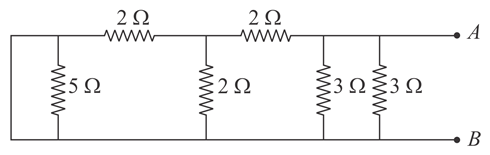
The equivalent resistance of the given circuit between the terminals $$A$$ and $$B$$ is:
Here is the formatted, step-by-step solution to find the equivalent resistance of the given circuit network.
Problem Statement
The equivalent resistance of the given circuit between terminals A and B is:
Step-by-Step Solution
To find the total equivalent resistance between terminals A and B, we analyze the circuit starting from the leftmost side and simplify it step-by-step moving towards the right.
Step 1: Analyze the Leftmost $$5\ \Omega$$ Resistor
Step 2: Parallel and Series Reductions
After removing the $$5\ \Omega$$ resistor, the first series $$2\ \Omega$$ resistor on the top branch is now connected in parallel across the middle vertical $$2\ \Omega$$ resistor.
$$R_{p1} = \frac{2 \times 2}{2 + 2} = 1\ \Omega$$
This $$1\ \Omega$$ equivalent resistance is now connected directly in series with the second top-branch $$2\ \Omega$$ resistor.
$$R_{\text{series}} = 1\ \Omega + 2\ \Omega = 3\ \Omega$$
On the far right, near terminals A and B, we have two vertical $$3\ \Omega$$ resistors connected in parallel with each other.
$$R_{p2} = \frac{3 \times 3}{3 + 3} = \frac{9}{6} = \frac{3}{2}\ \Omega$$
Step 3: Final Equivalent Resistance ($$R_{\text{eq}}$$)
Now, the remaining circuit is simply our simplified series branch ($$3\ \Omega$$) connected in parallel across the terminal pair's combined resistance ($$\frac{3}{2}\ \Omega$$):
$$R_{\text{eq}} = \frac{3 \times \frac{3}{2}}{3 + \frac{3}{2}}$$
$$R_{\text{eq}} = \frac{\frac{9}{2}}{\frac{9}{2}} = 1\ \Omega$$
Correct Answer
The correct option is (4) $$1\ \Omega$$.
Was this solution helpful?
Create a FREE account and get:
_1.webp)

Educational materials for JEE preparation

Ask our AI anything

AI can make mistakes. Please verify important information.
AI can make mistakes. Please verify important information.
