
Join Our JEE Preparation Group
Prep with like-minded aspirants; Get access to free daily tests and study material.
Sign in
Please select an account to continue using cracku.in
↓ →
Join Our JEE Preparation Group
Prep with like-minded aspirants; Get access to free daily tests and study material.
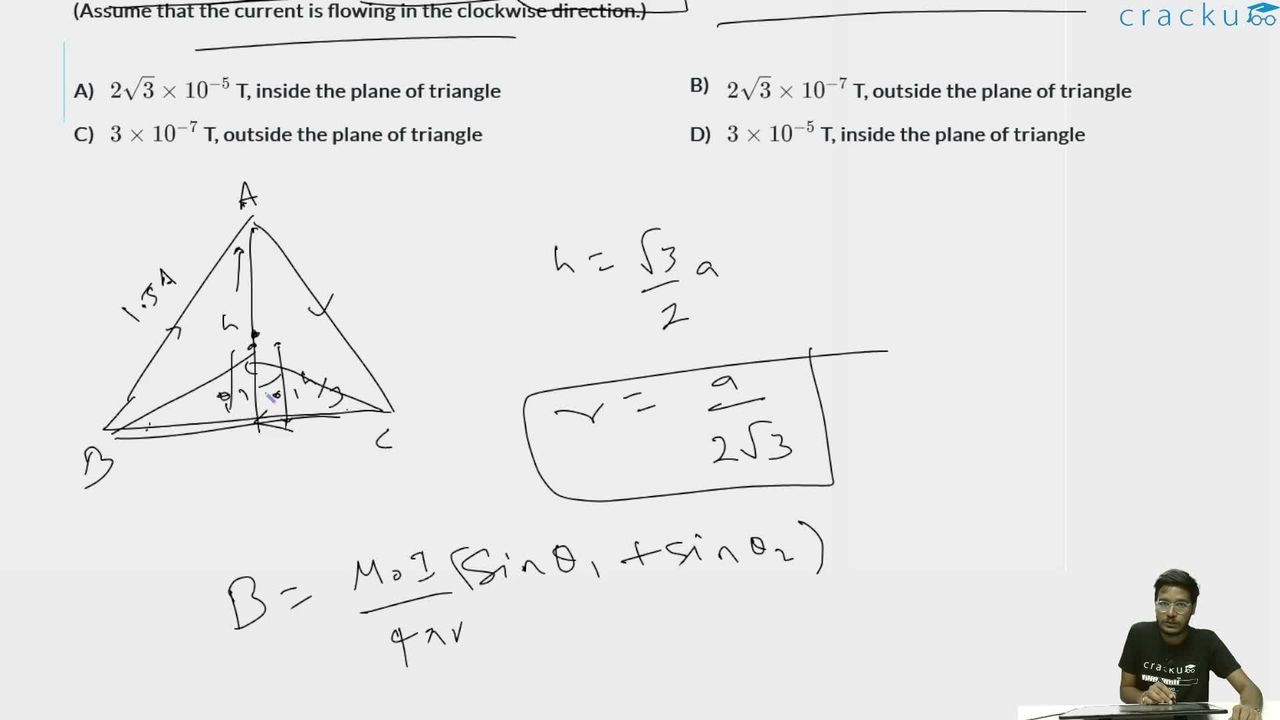
A current of 1.5 A is flowing through a triangle, of side 9 cm each. The magnetic field at the centroid of the triangle is:
(Assume that the current is flowing in the clockwise direction.)
First recall the magnetic-field formula for a straight, finite conductor. For a wire segment of length $$L$$ that carries current $$I$$, the field at a point that is at a perpendicular distance $$r$$ from the wire and that “sees’’ the two ends under angles $$\theta_1$$ and $$\theta_2$$ (measured from the perpendicular) is
$$ B=\dfrac{\mu_0 I}{4\pi r}\,(\sin\theta_1+\sin\theta_2), $$
and the direction is obtained from the right-hand rule for the element $$I\,\vec{\mathrm d\ell}\times\vec r$$.
The triangle is equilateral with side
$$ a = 9\ \text{cm}=0.09\ \text{m}, $$
and the current is $$I = 1.5\ \text{A}$$, flowing clockwise. The point at which we need the field is the centroid $$G$$. In an equilateral triangle the perpendicular distance from the centroid to any side is one third of the altitude. The altitude is
$$ h = a\dfrac{\sqrt{3}}{2}, $$
so the required distance is
$$ r = \dfrac{h}{3}= \dfrac{a}{3}\,\dfrac{\sqrt{3}}{2} = a\,\dfrac{\sqrt{3}}{6} = 0.09\ \text{m}\times\dfrac{\sqrt{3}}{6}. $$
Numerically, using $$\sqrt{3}=1.732$$,
$$ r = 0.09\times\dfrac{1.732}{6} = 0.09\times0.2887 \approx 0.02598\ \text{m}. $$
Because the centroid lies on the perpendicular bisector of every side, the two angles for each side are equal: $$\theta_1=\theta_2=\theta$$. The half-length of a side is $$a/2$$, so
$$ \tan\theta = \dfrac{a/2}{r} = \dfrac{0.09/2}{0.02598} = \dfrac{0.045}{0.02598} \approx 1.732 =\sqrt{3}. $$
Hence $$\theta=60^\circ$$ and
$$ \sin\theta = \sin60^\circ = \dfrac{\sqrt{3}}{2}. $$
Substituting $$\theta_1=\theta_2=60^\circ$$ in the straight-wire formula gives the field from one side:
$$ B_1 = \dfrac{\mu_0 I}{4\pi r}\, (\sin\theta+\sin\theta) = \dfrac{\mu_0 I}{4\pi r}\,(2\sin60^\circ) = \dfrac{\mu_0 I}{4\pi r}\, \left(2\times\dfrac{\sqrt{3}}{2}\right) = \dfrac{\mu_0 I\sqrt{3}}{4\pi r}. $$
Now insert the numerical values. We have $$\mu_0/4\pi = 10^{-7}\,{\rm T\,m\,A^{-1}}$$, so
$$ B_1 = 10^{-7} \times\dfrac{1.5\sqrt{3}}{0.02598} = 10^{-7} \times\dfrac{1.5\times1.732}{0.02598}. $$
The numerator is $$1.5\times1.732 = 2.598$$. Dividing,
$$ \dfrac{2.598}{0.02598}\approx 100.0. $$
Therefore
$$ B_1 \approx 100.0\times10^{-7}\ \text{T} = 1.0\times10^{-5}\ \text{T}. $$
The triangle has three identical sides, and by symmetry each contributes the same magnitude and the same axial direction, so the net field is
$$ B = 3B_1 = 3\times1.0\times10^{-5}\ \text{T} = 3.0\times10^{-5}\ \text{T}. $$
Finally, we determine the sense (into or out of the plane). Curl the fingers of your right hand in the direction of the current (clockwise as viewed from the front); the thumb then points into the page, that is, inside the plane of the triangle. All three side contributions add with this same orientation, so the resultant field is into the plane.
Hence, the correct answer is Option D.
Was this solution helpful?
Click on the Email ☝️ to Watch the Video Solution
Create a FREE account and get:
_1.webp)

Educational materials for JEE preparation

Ask our AI anything

AI can make mistakes. Please verify important information.
AI can make mistakes. Please verify important information.
