
Join Our JEE Preparation Group
Prep with like-minded aspirants; Get access to free daily tests and study material.
Sign in
Please select an account to continue using cracku.in
↓ →
Join Our JEE Preparation Group
Prep with like-minded aspirants; Get access to free daily tests and study material.
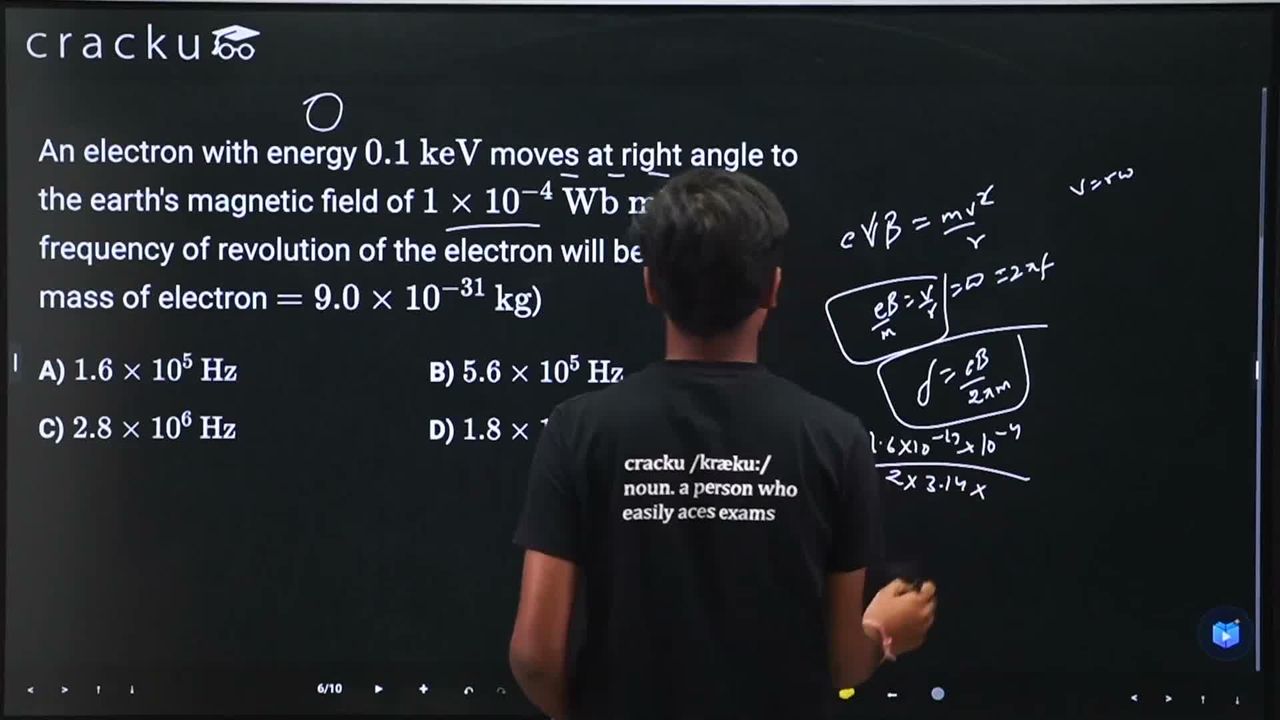
An electron with energy $$0.1 \text{ keV}$$ moves at right angle to the earth's magnetic field of $$1 \times 10^{-4} \text{ Wb m}^{-2}$$. The frequency of revolution of the electron will be (Take mass of electron $$= 9.0 \times 10^{-31} \text{ kg}$$)
We need to find the frequency of revolution of an electron moving at a right angle to the Earth's magnetic field.
When a charged particle moves perpendicular to a uniform magnetic field, the magnetic force provides the necessary centripetal force:
$$evB = \frac{mv^2}{r} \implies \frac{v}{r} = \frac{eB}{m}$$
Since the angular frequency is $$\omega = \frac{v}{r} = 2\pi f$$, the cyclotron frequency ($$f$$) is given by:
$$f = \frac{eB}{2\pi m}$$
Substitute the given values into the frequency formula:
$$f = \frac{1.6 \times 10^{-19} \times 1 \times 10^{-4}}{2 \times 3.14 \times 9.0 \times 10^{-31}}$$
$$f = \frac{1.6 \times 10^{-23}}{56.52 \times 10^{-31}}$$
$$f \approx 0.0283 \times 10^8\text{ Hz} = 2.83 \times 10^6\text{ Hz}$$
The frequency of revolution of the electron is approximately $$2.8 \times 10^6\text{ Hz}$$, which matches Option C.
Was this solution helpful?
Click on the Email ☝️ to Watch the Video Solution
Create a FREE account and get:
_1.webp)

Educational materials for JEE preparation

Ask our AI anything

AI can make mistakes. Please verify important information.
AI can make mistakes. Please verify important information.
