
Join Our JEE Preparation Group
Prep with like-minded aspirants; Get access to free daily tests and study material.
Sign in
Please select an account to continue using cracku.in
↓ →
Join Our JEE Preparation Group
Prep with like-minded aspirants; Get access to free daily tests and study material.
A small square loop of wire of side $$l$$ is placed inside a large square loop of wire $$L$$ ($$L \gg l$$). Both loops are coplanar and their centres coincide at point $$O$$ as shown in figure. The mutual inductance of the system is
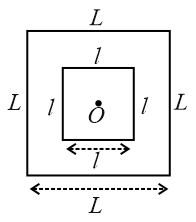
We need to determine the mutual inductance ($$M$$) of a system consisting of a small square loop of side $$l$$ placed inside a large square loop of side $$L$$ ($$L \gg l$$) such that they are coplanar and concentric.
Let a current $$I$$ flow through the large square loop. The loop consists of four identical linear segments of length $$L$$. The distance from each side to the common center $$O$$ is:
$$d = \frac{L}{2}$$
The magnetic field ($$B_1$$) produced at the center by a single straight wire segment of length $$L$$ carrying current $$I$$ is given by Biot-Savart Law:
$$B_1 = \frac{\mu_0 I}{4\pi d} (\sin \theta_1 + \sin \theta_2)$$
For a square loop, the lines connecting the center to the corners form angles of $$\theta_1 = \theta_2 = 45^\circ$$ with the normal. Substituting these along with $$d = \frac{L}{2}$$:
$$B_1 = \frac{\mu_0 I}{4\pi \left(\frac{L}{2}\right)} \left(\sin 45^\circ + \sin 45^\circ\right) = \frac{\mu_0 I}{2\pi L} \left(\frac{1}{\sqrt{2}} + \frac{1}{\sqrt{2}}\right) = \frac{\mu_0 I}{2\pi L} \left(\frac{2}{\sqrt{2}}\right) = \frac{\sqrt{2}\mu_0 I}{\pi L}$$
Since all four sides of the large loop contribute equally and in the same direction, the total magnetic field ($$B$$) at the center $$O$$ is:
$$B = 4 \times B_1 = 4 \times \frac{\sqrt{2}\mu_0 I}{\pi L} = \frac{4\sqrt{2}\mu_0 I}{\pi L}$$
Since the inner loop is extremely small ($$L \gg l$$), we can safely assume that the magnetic field $$B$$ is practically uniform across its entire inner area ($$A = l^2$$).
The magnetic flux ($$\Phi$$) linked with the small loop is:
$$\Phi = B \cdot A = \left(\frac{4\sqrt{2}\mu_0 I}{\pi L}\right) \cdot l^2 = \frac{4\sqrt{2}\mu_0 l^2 I}{\pi L}$$
By definition, the magnetic flux through the secondary loop is proportional to the current in the primary loop:
$$\Phi = M \cdot I$$
Equating the two expressions for $$\Phi$$ and canceling out the current ($$I$$):
$$M = \frac{4\sqrt{2}\mu_0 l^2}{\pi L}$$
The mutual inductance of the system is $$\frac{4\sqrt{2}\mu_0 l^2}{\pi L}$$.
Was this solution helpful?
Click on the Email ☝️ to Watch the Video Solution
Create a FREE account and get:
_1.webp)

Educational materials for JEE preparation

Ask our AI anything

AI can make mistakes. Please verify important information.
AI can make mistakes. Please verify important information.
