
Join Our JEE Preparation Group
Prep with like-minded aspirants; Get access to free daily tests and study material.
Sign in
Please select an account to continue using cracku.in
↓ →
Join Our JEE Preparation Group
Prep with like-minded aspirants; Get access to free daily tests and study material.
The magnetic moment of an electron ($$e$$) revolving in an orbit around nucleus with an orbital angular momentum is given by
We need to find the relation between the magnetic moment and the orbital angular momentum of an electron revolving around a nucleus.
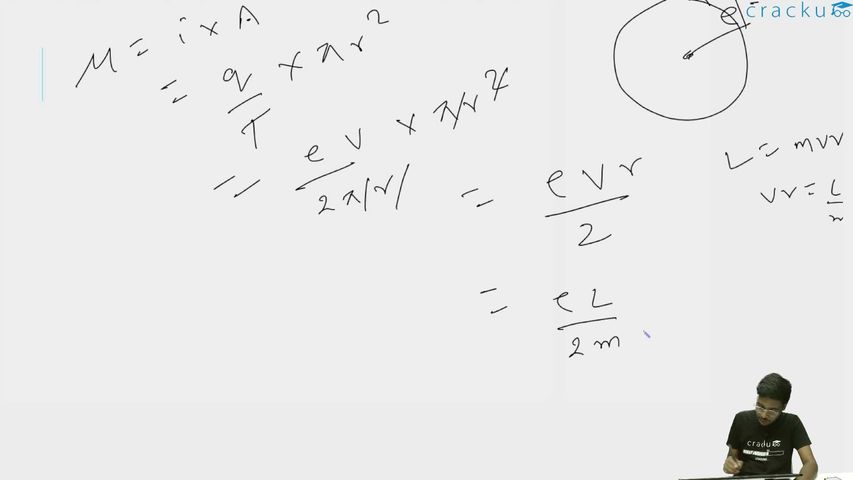
An electron moving in a circular orbit constitutes a current loop whose magnetic moment is given by $$\mu_L = iA$$, where $$i$$ is the current and $$A$$ is the area of the orbit.
The current due to the electron moving with period $$T$$ is $$i = \frac{e}{T} = \frac{ev}{2\pi r}$$, and the area of the circular orbit is $$A = \pi r^2$$.
Substituting these expressions gives $$\mu_L = \frac{ev}{2\pi r} \times \pi r^2 = \frac{evr}{2}$$.
Since the orbital angular momentum is $$L = mvr$$, it follows that $$vr = \frac{L}{m}$$, and therefore $$\mu_L = \frac{eL}{2m}$$.
For a negatively charged electron, the magnetic moment is opposite in direction to the angular momentum, so $$\vec{\mu}_L = -\frac{e\vec{L}}{2m}$$.
Hence, the correct answer is Option B.
Was this solution helpful?
Click on the Email ☝️ to Watch the Video Solution
Create a FREE account and get:
_1.webp)

Educational materials for JEE preparation

Ask our AI anything

AI can make mistakes. Please verify important information.
AI can make mistakes. Please verify important information.
