Join WhatsApp Icon JEE WhatsApp Group
Question 13


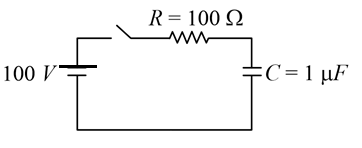
A capacitor of capacitance $$C = 1 \, \mu$$F is suddenly connected to a battery of 100 V through a resistance $$R = 100 \, \Omega$$. The time taken for the capacitor to be charged to get 50 V is:
(Take ln 2 = 0.69)

We need to determine the time taken for the capacitor in an RC circuit to charge up to a potential of 50 V.


1. Identify the Given Parameters

From the problem:

  • Capacitance ($$C$$) = $$1\ \mu\text{F} = 1 \times 10^{-6}\text{ F}$$
  • Resistance ($$R$$) = $$100\ \Omega$$
  • Battery Voltage ($$V_0$$) = $$100\text{ V}$$
  • Target Voltage ($$V_t$$) = $$50\text{ V}$$
  • Logarithmic constant: $$\ln 2 = 0.69$$

2. Apply the Capacitor Charging Formula

The instantaneous voltage ($$V_t$$) across a charging capacitor at time $$t$$ is governed by the following transient equation:

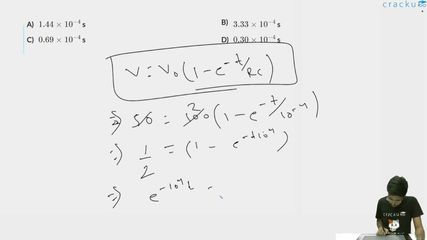
$$V_t = V_0 \left(1 - e^{-\frac{t}{RC}}\right)$$

Substitute our known parameters into this equation to solve for $$t$$:

$$50 = 100 \left(1 - e^{-\frac{t}{RC}}\right)$$

Divide both sides by 100:

$$0.5 = 1 - e^{-\frac{t}{RC}}$$

$$e^{-\frac{t}{RC}} = 1 - 0.5 = 0.5 = \frac{1}{2}$$


3. Solve for Time ($$t$$)

Take the natural logarithm ($$\ln$$) of both sides to remove the exponential function:

$$-\frac{t}{RC} = \ln\left(\frac{1}{2}\right) = -\ln 2$$

$$t = RC \ln 2$$

Now, calculate the circuit's time constant ($$\tau = RC$$):

$$RC = 100 \times (1 \times 10^{-6}) = 10^{-4}\text{ s}$$

Substitute the value of $$RC$$ and $$\ln 2$$ back into the time equation:

$$t = 10^{-4} \times 0.69 = 0.69 \times 10^{-4}\text{ s}$$


Conclusion

The time taken for the capacitor to be charged to 50 V is $$0.69 \times 10^{-4}\text{ s}$$, which corresponds exactly to Option C.

Get AI Help

Video Solution

video

Create a FREE account and get:

  • Free JEE Mains Previous Papers PDF
  • Take JEE Mains paper tests

JEE Quant Questions | JEE Quantitative Ability

JEE DILR Questions | LRDI Questions For JEE

JEE Verbal Ability Questions | VARC Questions For JEE

Free JEE Topicwise Questions

JEE Rotational MotionJEE Units & MeasurementsJEE Atomic StructureJEE GravitationJEE Periodic Table & PeriodicityJEE StatisticsJEE Inverse Trigonometric FunctionsJEE Magnetism & Magnetic MaterialsJEE Sequences & SeriesJEE MatricesJEE Alternating CurrentsJEE Carboxylic AcidsJEE Permutations & CombinationsJEE Work, Energy & PowerJEE Electromagnetic InductionJEE Electronic DevicesJEE d and f-Block ElementsJEE Chemical KineticsJEE Heat TransferJEE Three Dimensional GeometryJEE Magnetic Effects of CurrentJEE Hydrocarbons - AromaticJEE Electromagnetic WavesJEE Aldehydes & KetonesJEE Hydrocarbons - AlkanesJEE Applications of DerivativesJEE EquilibriumJEE Indefinite IntegrationJEE Chemical ThermodynamicsJEE ElectrochemistryJEE ProbabilityJEE BiomoleculesJEE Continuity & DifferentiabilityJEE Kinetic Theory of GasesJEE Vector AlgebraJEE Hydrocarbons - AlkynesJEE Differential EquationsJEE Current & ResistanceJEE Straight LinesJEE WavesJEE Redox ReactionsJEE Hydrocarbons - AlkenesJEE DeterminantsJEE SolutionsJEE Ray OpticsJEE Dual Nature of Matter & RadiationJEE Chemical Bonding & Molecular StructureJEE Complex NumbersJEE Sets, Relations & FunctionsJEE Electric Charges & FieldsJEE Laws of MotionJEE Fluid MechanicsJEE Basic Concepts in ChemistryJEE Trigonometric FunctionsJEE LimitsJEE Laws of ThermodynamicsJEE Kinematics - 2D MotionJEE p-Block Elements (Groups 13-18)JEE Simple Harmonic MotionJEE Electric Potential & CapacitanceJEE Coordination CompoundsJEE JEE 2D GeometryJEE CirclesJEE Definite IntegrationJEE EMF & Circuit AnalysisJEE Surface TensionJEE Atoms & NucleiJEE Laboratory Experiments - XIJEE Number SystemJEE Basic Principles of Organic ChemistryJEE Wave OpticsJEE Quadratic EquationsJEE Alcohols, Phenols & EthersJEE Organic Compounds with HalogensJEE DifferentiationJEE Conic SectionsJEE Nitrogen-Containing CompoundsJEE ElasticityJEE Practical Organic ChemistryJEE Kinematics - 1D MotionJEE Purification & CharacterisationJEE Binomial Theorem
Ask AI