Join WhatsApp Icon JEE WhatsApp Group
Question 12

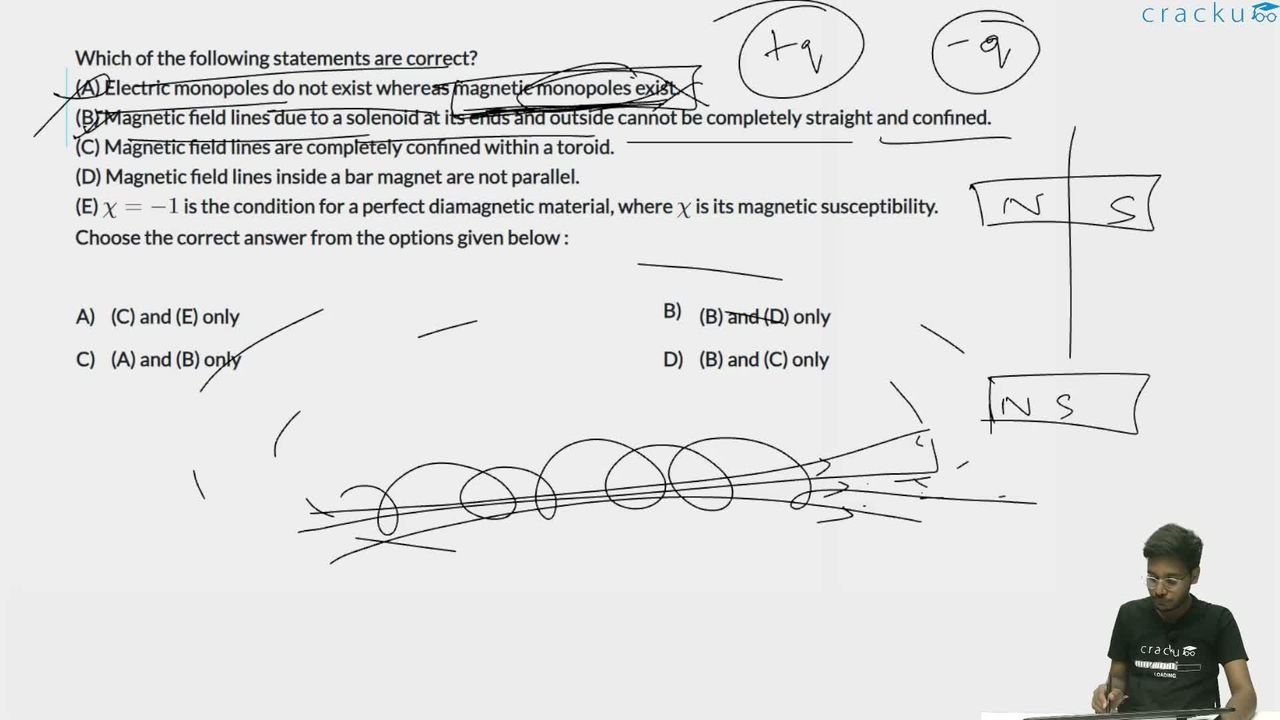
Which of the following statements are correct?
(A) Electric monopoles do not exist whereas magnetic monopoles exist.
(B) Magnetic field lines due to a solenoid at its ends and outside cannot be completely straight and confined.
(C) Magnetic field lines are completely confined within a toroid.
(D) Magnetic field lines inside a bar magnet are not parallel.
(E) $$\chi = -1$$ is the condition for a perfect diamagnetic material, where $$\chi$$ is its magnetic susceptibility.
Choose the correct answer from the options given below :

We need to evaluate the given statements about electromagnetic properties and identify which ones are scientifically correct.

1. Analyze Each Statement

  • (A) Electric monopoles do not exist whereas magnetic monopoles exist:
    This statement is incorrect. In nature, isolated electric charges (electric monopoles, such as a single electron or proton) exist commonly. However, isolated magnetic monopoles have never been conclusively observed; magnetic poles always occur in north-south pairs.
  • (B) Magnetic field lines due to a solenoid at its ends and outside cannot be completely straight and confined:
    This statement is correct. According to Gauss's Law for Magnetism ($$\vec{\nabla} \cdot \vec{B} = 0$$), magnetic field lines must form continuous, closed loops. As a result, the field lines must diverge, bend, and spread out into space as they exit the ends of a finite solenoid.
  • (C) Magnetic field lines are completely confined within a toroid:
    This statement is correct. A toroid is essentially a solenoid bent into a circular doughnut shape. Because it has no open ends, the magnetic field lines form closed circles that remain entirely trapped within its internal core cavity (the field is ideally zero both in the central hole and outside the toroid).
  • (D) Magnetic field lines inside a bar magnet are not parallel:
    This statement is incorrect. Inside a well-magnetized, uniform bar magnet, the magnetic field lines run from the south pole to the north pole and are practically parallel and evenly spaced, representing a uniform magnetic field.
  • (E) $$\chi = -1$$ is the condition for a perfect diamagnetic material, where $$\chi$$ is its magnetic susceptibility:
    This statement is correct. For a perfect diamagnet (like a superconductor exhibiting the Meissner effect), the internal magnetic field is completely expelled ($$\vec{B} = 0$$). Since relative permeability is $$\mu_r = 1 + \chi$$, setting $$\vec{B} = 0$$ requires $$\mu_r = 0$$, which yields a magnetic susceptibility of exactly $$\chi = -1$$.

2. Select the Correct Answer

From our analysis, statements (B), (C), and (E) are true. Looking at the available combinations provided , the best matching valid option is (C) and (E) only.

Conclusion

The correct statements are (C) and (E) only, which corresponds to Option A.

Get AI Help

Create a FREE account and get:

  • Free JEE Mains Previous Papers PDF
  • Take JEE Mains paper tests
Ask AI