
Join Our JEE Preparation Group
Prep with like-minded aspirants; Get access to free daily tests and study material.
Sign in
Please select an account to continue using cracku.in
↓ →
Join Our JEE Preparation Group
Prep with like-minded aspirants; Get access to free daily tests and study material.
Let $$\frac{\pi}{2} < \theta < \pi$$ and $$\cot \theta = -\frac{1}{2\sqrt{2}}$$. Then the value of $$\sin \left(\frac{15\theta}{2}\right) (\cos 8\theta + \sin 8\theta) + \cos \left(\frac{15\theta}{2}\right) (\cos 8\theta - \sin 8\theta)$$ is equal to
1. Expand and Group
Let the given expression be $$E$$:
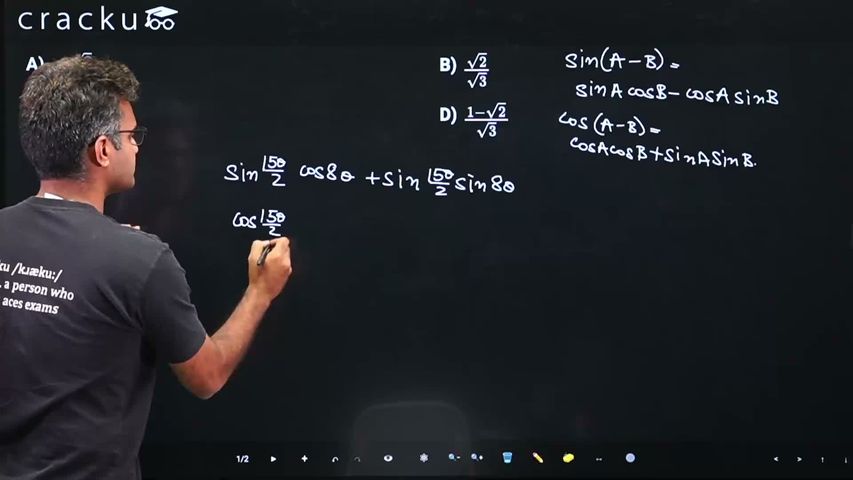
$$E = \sin\left(\frac{15\theta}{2}\right) (\cos 8\theta + \sin 8\theta) + \cos\left(\frac{15\theta}{2}\right) (\cos 8\theta - \sin 8\theta)$$
Multiply everything out to remove the brackets:
$$E = \sin\left(\frac{15\theta}{2}\right)\cos 8\theta + \sin\left(\frac{15\theta}{2}\right)\sin 8\theta + \cos\left(\frac{15\theta}{2}\right)\cos 8\theta - \cos\left(\frac{15\theta}{2}\right)\sin 8\theta$$
Now, rearrange the terms to form standard trigonometric identities:
$$E = \left[ \cos\left(\frac{15\theta}{2}\right)\cos 8\theta + \sin\left(\frac{15\theta}{2}\right)\sin 8\theta \right] + \left[ \sin\left(\frac{15\theta}{2}\right)\cos 8\theta - \cos\left(\frac{15\theta}{2}\right)\sin 8\theta \right]$$
2. Apply Compound Angle Formulas
We can use the standard identities $$\cos A \cos B + \sin A \sin B = \cos(A - B)$$ and $$\sin A \cos B - \cos A \sin B = \sin(A - B)$$. Let $$A = \frac{15\theta}{2}$$ and $$B = 8\theta$$:
$$E = \cos\left(\frac{15\theta}{2} - 8\theta\right) + \sin\left(\frac{15\theta}{2} - 8\theta\right)$$
$$E = \cos\left(-\frac{\theta}{2}\right) + \sin\left(-\frac{\theta}{2}\right)$$
Since cosine is an even function and sine is an odd function, this reduces nicely to:
$$E = \cos\left(\frac{\theta}{2}\right) - \sin\left(\frac{\theta}{2}\right)$$
3. Find the value of $$\cos \theta$$
We are given $$\cot \theta = -\frac{1}{2\sqrt{2}}$$ in the second quadrant where $$\frac{\pi}{2} < \theta < \pi$$.
Using a right triangle, the adjacent side is $$-1$$ and the opposite side is $$2\sqrt{2}$$.
The hypotenuse will be $$\sqrt{(-1)^2 + (2\sqrt{2})^2} = \sqrt{1 + 8} = 3$$.
Therefore, $$\cos \theta = -\frac{1}{3}$$.
4. Calculate the Half Angle Values
First, find the quadrant for the half angle. Dividing the given domain by 2 gives:
$$\frac{\pi}{4} < \frac{\theta}{2} < \frac{\pi}{2}$$
This is entirely in the first quadrant, so both the sine and cosine of $$\frac{\theta}{2}$$ will be positive.
Apply the half angle formulas:
$$\cos\left(\frac{\theta}{2}\right) = \sqrt{\frac{1 + \cos \theta}{2}} = \sqrt{\frac{1 + \left(-\frac{1}{3}\right)}{2}} = \sqrt{\frac{2/3}{2}} = \frac{1}{\sqrt{3}}$$
$$\sin\left(\frac{\theta}{2}\right) = \sqrt{\frac{1 - \cos \theta}{2}} = \sqrt{\frac{1 - \left(-\frac{1}{3}\right)}{2}} = \sqrt{\frac{4/3}{2}} = \frac{\sqrt{2}}{\sqrt{3}}$$
5. Final Answer
Substitute these values back into our simplified equation for $$E$$:
$$E = \frac{1}{\sqrt{3}} - \frac{\sqrt{2}}{\sqrt{3}}$$
$$E = \frac{1 - \sqrt{2}}{\sqrt{3}}$$
Hence, the correct option is D.
Was this solution helpful?
Click on the Email ☝️ to Watch the Video Solution
Create a FREE account and get:
_1.webp)

Educational materials for JEE preparation

Ask our AI anything

AI can make mistakes. Please verify important information.
AI can make mistakes. Please verify important information.
