
Join Our JEE Preparation Group
Prep with like-minded aspirants; Get access to free daily tests and study material.
Sign in
Please select an account to continue using cracku.in
↓ →
Join Our JEE Preparation Group
Prep with like-minded aspirants; Get access to free daily tests and study material.
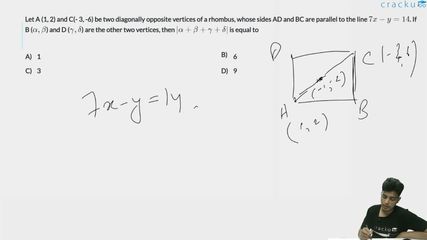
Let A (1, 2) and C(- 3, -6) be two diagonally opposite vertices of a rhombus, whose sides AD and BC are parallel to the line $$7x - y = 14$$. If B ($$ \alpha, \beta $$) and D ($$ \gamma, \delta $$) are the other two vertices, then $$|\alpha+ \beta+\gamma+\delta |$$ is equal to
Given:
Vertices $$A(1, 2)$$ and $$C(-3, -6)$$ are diagonally opposite.
Sides $$AD$$ and $$BC$$ are parallel to $$7x - y = 14$$ (Slope $$m = 7$$).
Find $$|\alpha + \beta + \gamma + \delta|$$ where $$B(\alpha, \beta)$$ and $$D(\gamma, \delta)$$.
Midpoint of Diagonals: In a rhombus, diagonals bisect each other. The midpoint $$M$$ of $$AC$$ is also the midpoint of $$BD$$.
$$M = \left( \frac{1-3}{2}, \frac{2-6}{2} \right) = (-1, -2)$$
Since $$M$$ is the midpoint of $$BD$$:
$$\frac{\alpha + \gamma}{2} = -1 \implies \alpha + \gamma = -2$$
$$\frac{\beta + \delta}{2} = -2 \implies \beta + \delta = -4$$
$$\alpha + \beta + \gamma + \delta = (\alpha + \gamma) + (\beta + \delta) = -2 + (-4) = -6$$
$$|-6| = 6$$
Was this solution helpful?
Click on the Email ☝️ to Watch the Video Solution
Create a FREE account and get:
_1.webp)

Educational materials for JEE preparation

Ask our AI anything

AI can make mistakes. Please verify important information.
AI can make mistakes. Please verify important information.
