
Join Our JEE Preparation Group
Prep with like-minded aspirants; Get access to free daily tests and study material.
Sign in
Please select an account to continue using cracku.in
↓ →
Join Our JEE Preparation Group
Prep with like-minded aspirants; Get access to free daily tests and study material.
We need to determine the correct relationship between the true dip ($$\delta$$) and the apparent dip ($$\delta'$$) in Earth's magnetism.
In the true magnetic meridian, let the horizontal component of Earth's magnetic field be $$B_H$$ and the vertical component be $$B_V$$. The true dip angle $$\delta$$ is given by:
$$\tan \delta = \frac{B_V}{B_H} \quad \text{--- (Equation 1)}$$
Now, consider another vertical plane that makes an angle $$\alpha$$ with the true magnetic meridian. In this new plane:
The apparent dip $$\delta'$$ measured in this plane is given by:
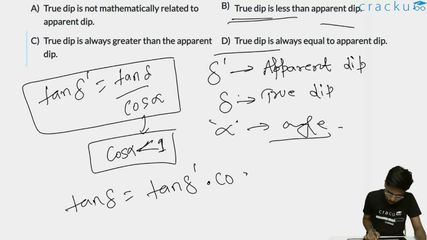
$$\tan \delta' = \frac{B_V'}{B_H'} = \frac{B_V}{B_H \cos \alpha}$$
Using the value from Equation 1 ($$\frac{B_V}{B_H} = \tan \delta$$), we can rewrite the equation for apparent dip as:
$$\tan \delta' = \frac{\tan \delta}{\cos \alpha}$$
$$\tan \delta = \tan \delta' \cdot \cos \alpha$$
For any plane other than the true magnetic meridian, the angle $$\alpha$$ is between $$0^\circ$$ and $$90^\circ$$ ($$0^\circ < \alpha < 90^\circ$$). In this range, the value of cosine is always a fraction less than $$1$$:
$$\cos \alpha < 1$$
Therefore, multiplying $$\tan \delta'$$ by a fraction less than $$1$$ makes it equal to $$\tan \delta$$:
$$\tan \delta < \tan \delta' \implies \delta < \delta'$$
Since the angle of true dip is smaller than the angle of apparent dip, it means that the True dip is less than apparent dip.
Final Answer: Option B (True dip is less than apparent dip.)
Was this solution helpful?
Click on the Email ☝️ to Watch the Video Solution
Create a FREE account and get:
_1.webp)

Educational materials for JEE preparation

Ask our AI anything

AI can make mistakes. Please verify important information.
AI can make mistakes. Please verify important information.
