
Join Our JEE Preparation Group
Prep with like-minded aspirants; Get access to free daily tests and study material.
Sign in
Please select an account to continue using cracku.in
↓ →
Join Our JEE Preparation Group
Prep with like-minded aspirants; Get access to free daily tests and study material.
Two ideal electric dipoles $$A$$ and $$B$$, having their dipole moment $$p_1$$ and $$p_2$$ respectively are placed on a plane with their centres at $$O$$ as shown in the figure. At point $$C$$ on the axis of dipole $$A$$, the resultant electric field is making an angle of 37° with the axis. The ratio of the dipole moment of $$A$$ and $$B$$, $$\frac{p_1}{p_2}$$ is: (take sin 37° = $$\frac{3}{5}$$)
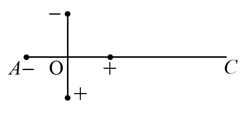
We need to find the ratio of the dipole moments of two ideal electric dipoles, $$\frac{p_1}{p_2}$$, based on the direction of the net electric field at point $$C$$.
From the diagram :
$$E_1 = \frac{1}{4\pi\varepsilon_0} \frac{2p_1}{r^3}$$
$$E_2 = \frac{1}{4\pi\varepsilon_0} \frac{p_2}{r^3}$$
The problem states that the net resultant electric field at point $$C$$ makes an angle of $$37^\circ$$ with the axis of dipole $$A$$. Using vector components:
$$\tan(37^\circ) = \frac{E_2}{E_1}$$
Given that $$\sin(37^\circ) = \frac{3}{5}$$, we know from a standard $$3-4-5$$ right triangle that:
$$\tan(37^\circ) = \frac{3}{4}$$
Substitute the expressions for $$E_1$$ and $$E_2$$ into the tangent relationship:
$$\frac{3}{4} = \frac{\frac{1}{4\pi\varepsilon_0} \frac{p_2}{r^3}}{\frac{1}{4\pi\varepsilon_0} \frac{2p_1}{r^3}}$$
Cancel out the common constant factors ($$4\pi\varepsilon_0$$ and $$r^3$$):
$$\frac{3}{4} = \frac{p_2}{2p_1}$$
Cross-multiply to isolate the desired ratio:
$$\frac{p_1}{p_2} = \frac{4}{2 \times 3} = \frac{4}{6} = \frac{2}{3}$$
The ratio of the dipole moments $$\frac{p_1}{p_2}$$ is $$\frac{2}{3}$$, which corresponds exactly to Option C.
Was this solution helpful?
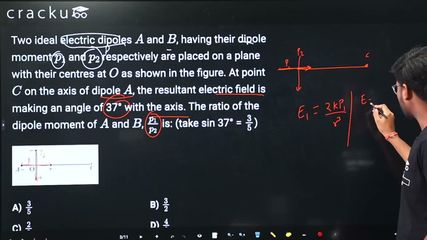
Click on the Email ☝️ to Watch the Video Solution
Create a FREE account and get:
_1.webp)

Educational materials for JEE preparation

Ask our AI anything

AI can make mistakes. Please verify important information.
AI can make mistakes. Please verify important information.
